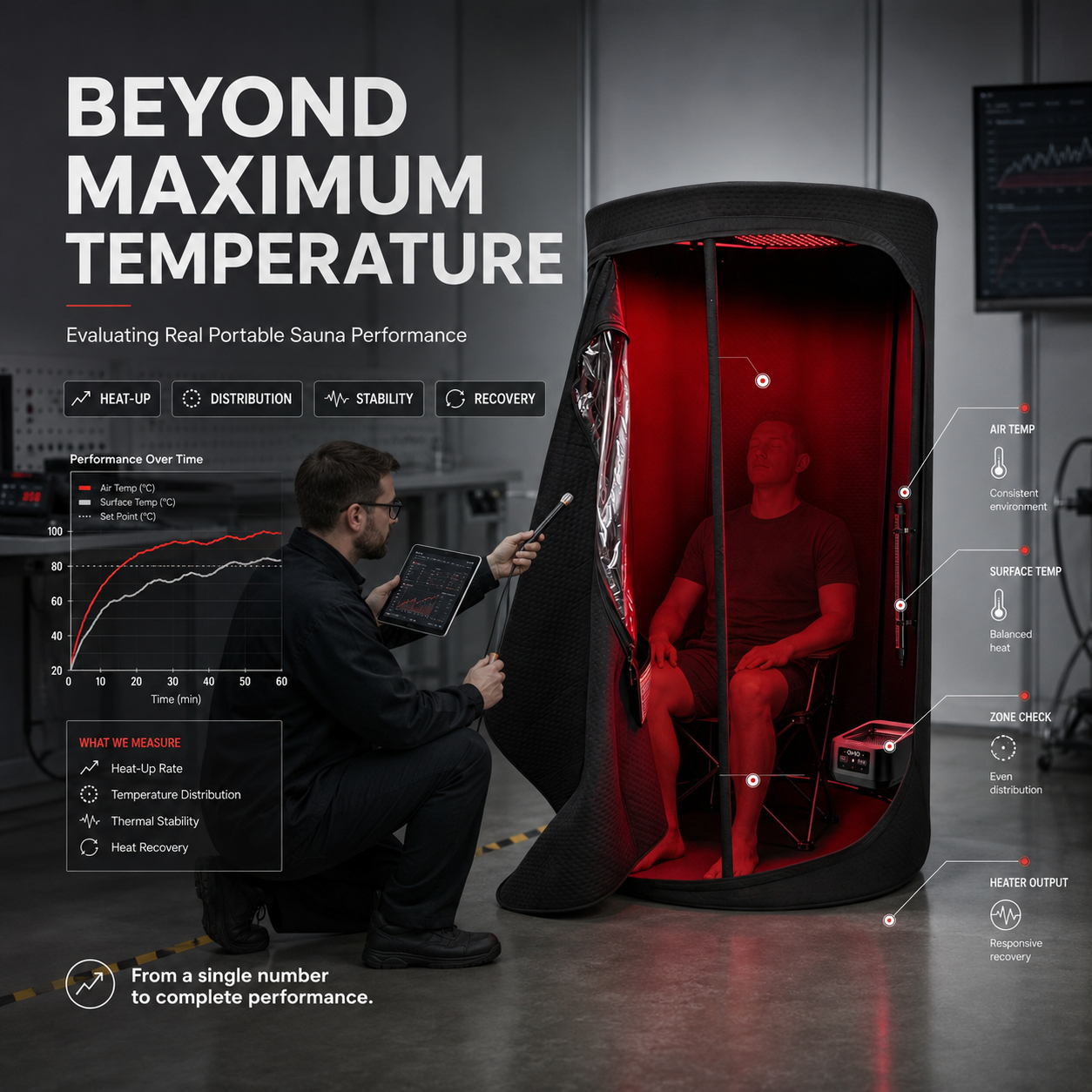
When buyers compare portable saunas, one number often dominates the conversation:
What is the maximum temperature?
It is an understandable question. Temperature is easy to communicate, easy to place on a product page and easy to compare with competing products.
But maximum temperature is not the same as complete performance.
A sauna may briefly reach an impressive temperature while empty, yet perform very differently when a person is seated inside. Another sauna may show a slightly lower peak reading but deliver faster warm-up, more even heat around the body and better temperature stability throughout the session.
The real question is therefore not simply:
How hot can the sauna become?
It is:
How effectively, consistently and safely does the sauna create the intended thermal experience under realistic conditions?
To answer that question, buyers need to look beyond one peak number and examine the entire heating system.
Maximum temperature is not a meaningless specification.
For a hot-air sauna, it can help indicate whether the heater and insulated enclosure are capable of creating a high-temperature environment. For an infrared sauna, the operating temperature range helps users understand that the product delivers radiant warmth without relying entirely on extremely hot air.
The problem begins when a maximum-temperature claim is presented without its test conditions.
A temperature reading is meaningful only when the following information is also known:
Without this context, two apparently identical temperature claims may represent very different product performance.
Temperature inside a sauna is not perfectly uniform.
In a hot-air system, heated air rises because it is less dense than cooler air. As a result, the upper area can become significantly hotter than the lower area. Airflow, ventilation, heater location and enclosure shape also influence where heat accumulates. Thermal modelling of conventional saunas similarly shows that heat-up time and temperature distribution at user level are separate performance questions.
An infrared system adds another layer. A user can receive radiant energy directly from surrounding heating elements, so air temperature alone does not fully describe the thermal sensation.
More broadly, thermal perception depends on multiple factors, including air temperature, radiant temperature, air speed and humidity. ASHRAE uses these as separate environmental variables in thermal-comfort assessment, although its building comfort standard should not be treated as a sauna performance standard.
This means that a single sensor cannot tell buyers:
A maximum temperature is therefore a point measurement—not a complete map of the experience.
A common performance claim states that a sauna reaches a target temperature within a certain number of minutes.
That is useful, but buyers should ask to see the entire heat-up curve rather than only the finishing number.
A proper curve records temperature continuously or at fixed intervals from startup until the system reaches a stable operating condition.
It can reveal four distinct stages:
How quickly does the heater begin transferring useful heat into the enclosure?
Does the temperature increase steadily, or does the system stall for long periods?
Does the heater reach the target smoothly, or overshoot it before the controller responds?
Can the sauna maintain the intended temperature, or does it repeatedly rise and fall through a wide range?
Two products may both reach 75°C. One may reach it in 20 minutes and maintain a narrow operating band. The other may require 35 minutes, touch 75°C briefly and then fall substantially when the heater cycles off.
Both products can technically advertise the same maximum temperature, but their user experience is not the same.
Instead of publishing only:
Maximum temperature: 75°C
a stronger performance report would include:
Starting room temperature: 23°C
Time to 60°C: 14 minutes
Time to 70°C: 20 minutes
Stable operating range after warm-up: 68–73°C
Sensor location: seated torso zone
Test duration: 60 minutes
The exact figures will depend on the product. The important principle is transparency.
An empty sauna is easier to heat than a sauna containing a person, chair and other internal components.
Once occupied, several conditions change:
For this reason, an empty-tent laboratory result should not be assumed to represent the full user experience.
Controlled research on portable sauna products also demonstrates the value of defined test protocols. A 2023 study assessed five portable steam sauna pods across nine settings, recording temperature and relative humidity every five minutes for 70 minutes before evaluating physiological responses during occupied sessions. The study illustrates why repeatability, time-series data and between-unit comparison are more informative than a single peak reading.
A manufacturer can evaluate performance in three stages:
Stage 1: Empty enclosure
Used to establish the basic heat-up curve, heat loss and controller behaviour.
Stage 2: Representative occupied load
Uses an appropriate test load, thermal manikin or controlled human-use protocol to identify how occupancy changes performance.
Stage 3: Realistic session
Includes entry, sitting position, normal ventilation settings and a complete operating period.
Human testing should only be conducted under an appropriate safety protocol with defined exposure limits, monitoring and stop criteria. Product testing must also follow the relevant requirements of the intended sales market.
A temperature reading without a measurement location is incomplete.
The sensor may be:
These locations can produce substantially different readings.
Sauna-heater manufacturer HUUM, for example, notes that thermometer and controller readings can differ when their sensors are placed in different thermal zones. It also warns against positioning a control sensor too close to the heater, door, window or ventilation opening. The exact required sensor position remains product- and system-specific and should follow the applicable instructions and safety requirements.
This sensor is part of the product’s operating and safety system. It tells the controller when to increase, reduce or stop heating.
This independent sensor is used to evaluate the actual thermal environment at a defined user position.
They do not necessarily need to be in the same location.
Moving the control sensor simply to produce a higher controller reading can damage regulation accuracy or conflict with the approved safety design. Performance testing should therefore use independent, calibrated instruments without casually changing the product’s control architecture.
ISO 7726:2025 specifies characteristics and methods for instruments used to measure physical quantities in thermal environments. It is not a portable-sauna ranking standard, but its measurement principles reinforce the importance of appropriate instruments and clearly defined procedures.
A better sauna test uses several measurement points.
For a seated single-person sauna, useful locations may include:
| Measurement zone | What it helps evaluate |
|---|---|
| Head or shoulder level | Upper-zone heat accumulation |
| Chest or torso level | Main seated thermal environment |
| Knee level | Mid-to-lower body coverage |
| Lower-leg or foot level | Cold-zone risk |
| Near the door | Air leakage and heat loss |
| Near—but not touching—the heater | Local heat concentration |
| Opposite side of the enclosure | Left-to-right uniformity |
The exact locations should be adapted to the product structure and intended user position.
The goal is not to make every point identical. Natural temperature differences will exist. The goal is to understand whether those differences support the intended experience or create uncomfortable hot and cold zones.
For infrared products, air probes should be combined with:
A high air temperature does not prove even radiant coverage. Likewise, moderate air temperature does not mean the infrared system is weak.
A sauna session takes place over time.
After warm-up, the controller repeatedly adjusts power to keep the system near its target. This can create a temperature cycle.
A well-controlled product should avoid:
Brands can request:
For example, a product that remains between 72°C and 76°C for most of the session may offer more predictable performance than a product that repeatedly swings between 65°C and 82°C—even if the second product advertises the higher maximum.
This does not mean the narrowest possible range is always best. The correct control behaviour depends on the heating technology, sensor response and product design. What matters is that the behaviour is known, repeatable and appropriate for the intended user experience.
A portable sauna is not operated as a sealed laboratory chamber.
The user opens the door to enter. During a session, the door may be opened again to adjust the chair, retrieve water or exit briefly.
Each opening releases warm air.
A practical performance test should therefore record:
This is the temperature-recovery test.
A sauna with a high empty peak but weak recovery may feel slow or inconsistent in real use. A system with effective heating output, insulation and airflow management may recover more quickly even if its published maximum is slightly lower.
Recovery testing also helps evaluate:
Portable products are strongly influenced by their surroundings.
Performance may change according to:
A claim measured in a warm, still room cannot automatically be expected in a cold garage or outdoor winter environment.
The objective is not to eliminate every real-world variation. It is to make the result reproducible and understandable.
Testing only the best-performing sample does not show production consistency.
A reliable product program should compare several units from representative production.
The test can examine:
The earlier portable steam-pod study found strong agreement between five units at higher settings, while lower settings showed less consistent inter-unit reliability. That finding applies to the specific products and protocol studied, but the broader lesson is useful: performance should be evaluated for both capability and repeatability.
For a brand, consistent units are often more valuable than one exceptional prototype.
Performance testing answers questions such as:
Safety evaluation addresses different questions, including:
IEC 60335-2-53 covers safety requirements for electric sauna heating appliances and infrared-emitting units within its scope. Compliance or certification should be evaluated for the final product and target market; a strong performance result does not replace safety assessment.
The reverse is also true:
A product can satisfy applicable safety requirements without necessarily offering the fastest, most uniform or most comfortable thermal experience.
Brands need both.
Instead of comparing products only by maximum temperature, use a wider scorecard.
| Performance area | Question to ask | Evidence to request |
|---|---|---|
| Maximum temperature | What temperature can it reach? | Time-stamped test record |
| Heat-up speed | How quickly does it reach useful temperatures? | Complete heat-up curve |
| Sensor transparency | Where was temperature measured? | Sensor-location diagram |
| Occupied performance | How does a seated user change results? | Occupied or representative-load test |
| Vertical distribution | Are the head and legs heated appropriately? | Multi-height probe data |
| Horizontal distribution | Is one side hotter than the other? | Left/right measurements |
| Stability | Does it maintain the target range? | Stable-period min/max/average |
| Door recovery | How quickly does heat return after entry? | Recovery curve |
| Radiant coverage | Does infrared heat reach all intended zones? | Thermal imaging and layout drawing |
| Repeatability | Do different units perform similarly? | Multi-unit comparison |
| Electrical behaviour | Is power stable and appropriate? | Voltage, current and power logs |
| Safety | Is the final configuration evaluated for its market? | Applicable reports and certification documents |
No single metric replaces all the others.
Before selecting or developing a portable sauna, ask the supplier:
A supplier should not necessarily have one universal answer for every model. Different sauna technologies require different test priorities.
What matters is whether the supplier can explain the test method clearly and provide evidence that matches the claim.
The main priorities often include:
The main priorities often include:
The main priorities often include:
Maximum air temperatures from these three systems should not be treated as directly equivalent because their heat-transfer and humidity conditions differ.
A strong product page can still feature the maximum temperature prominently.
However, it should support that number with context.
A transparent presentation could include:
Up to XX°C under defined indoor test conditions
Tested at XX°C ambient temperature, rated voltage and specified sensor position. Actual performance may vary with room conditions, ventilation, occupancy and operating configuration.
It can then add:
This does more than protect the claim. It builds buyer confidence.
A carefully explained result is usually more credible than the largest unsupported number.
Maximum temperature remains an important specification, especially for products intended to deliver a high-temperature hot-air experience.
But real portable sauna performance is multidimensional.
It includes:
A high peak can attract attention.
A repeatable, well-documented thermal experience is what supports a reliable product.
For brands, the better question is no longer:
What is the highest temperature?
It is:
What evidence shows that the sauna performs well throughout a real session?
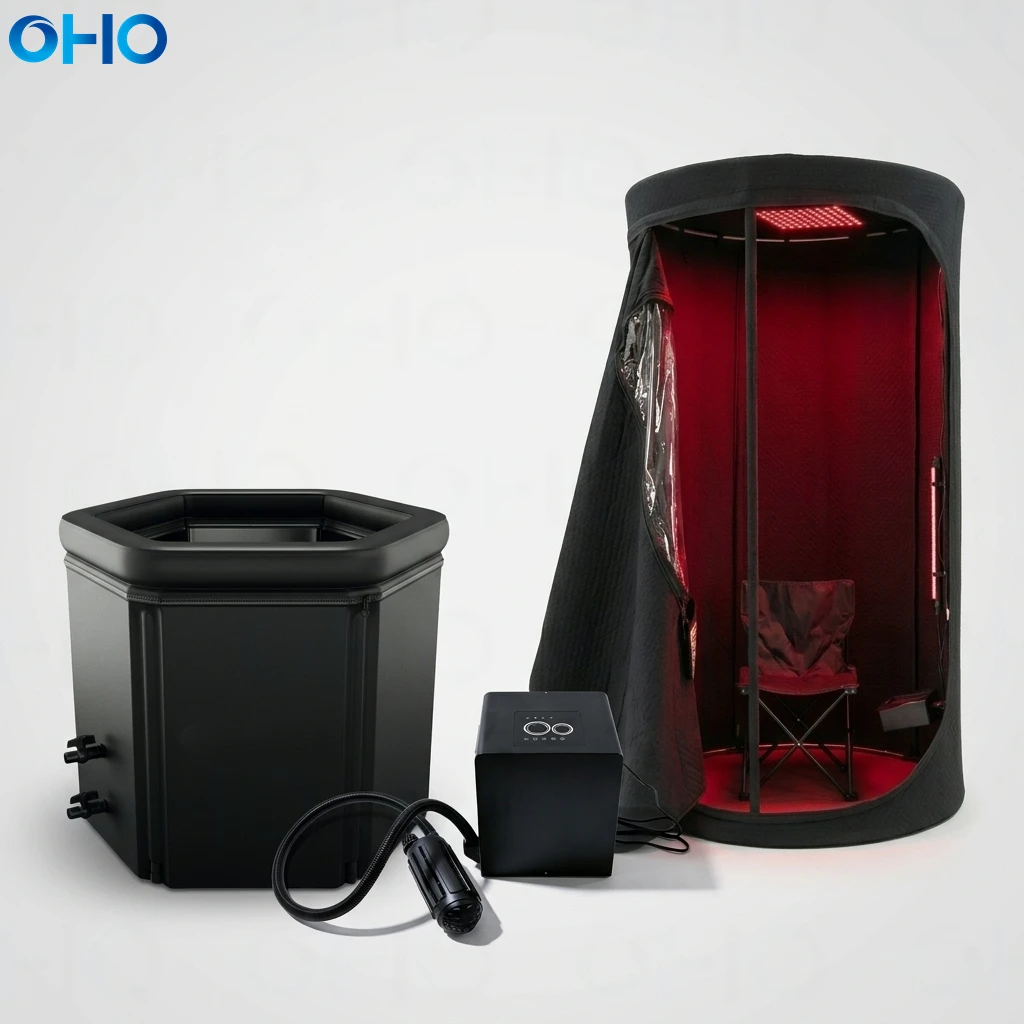
OHO’s current portable-sauna range includes far infrared and heated sauna categories for different consumer experiences and market positions.
When developing a new sauna program, the specification can be built around:
Contact OHO to discuss a portable sauna platform and a performance-validation plan aligned with your product positioning.
Yes. It helps describe the heating capability of the system. However, it should be evaluated together with heat-up speed, sensor location, stability, heat distribution and test conditions.
They may be positioned at different heights or near different heat sources, doors or vents. Temperature can vary substantially throughout a small heated enclosure. Instrument accuracy and response time can also contribute to differences.
A ceiling measurement can show upper-zone heat accumulation, but it does not necessarily represent what a seated user experiences. A useful test includes clearly defined measurements at user-relevant heights.
It is valid as a controlled baseline, but it should not be presented as a complete representation of occupied performance.
Not necessarily. Performance also depends on enclosure volume, insulation, airflow, heater design, supply voltage, control logic and heat loss.
Both matter. Peak temperature shows maximum capability, while stable temperature better describes what happens during the main part of a session.
No. Infrared systems include direct radiant heat, while hot-air systems rely more heavily on convection. Humidity, air movement, radiant exposure and session design also affect the experience.
Not necessarily. Safety certification and performance validation have different purposes. Buyers should review both applicable safety documentation and product-specific performance data.

 EN
EN