All Categories
Back

Drop-In vs. External-Loop Cold Plunge Cooling: A Systems Comparison for Brands and Buyers

Drop-In vs. External-Loop Cold Plunge Cooling: A Systems Comparison for Brands and Buyers

Drop-In vs. External-Loop Cold Plunge Cooling: A Systems Comparison for Brands and Buyers

Installation, Cooling Performance, Water Management, Maintenance and After-Sales Trade-Offs

A cold plunge is often presented as a simple combination:

A tub, water and a chiller.

In practice, the way these components are connected can significantly affect installation, temperature uniformity, water management, maintenance and after-sales support.

Two broad cooling architectures are increasingly common in the portable cold plunge market:

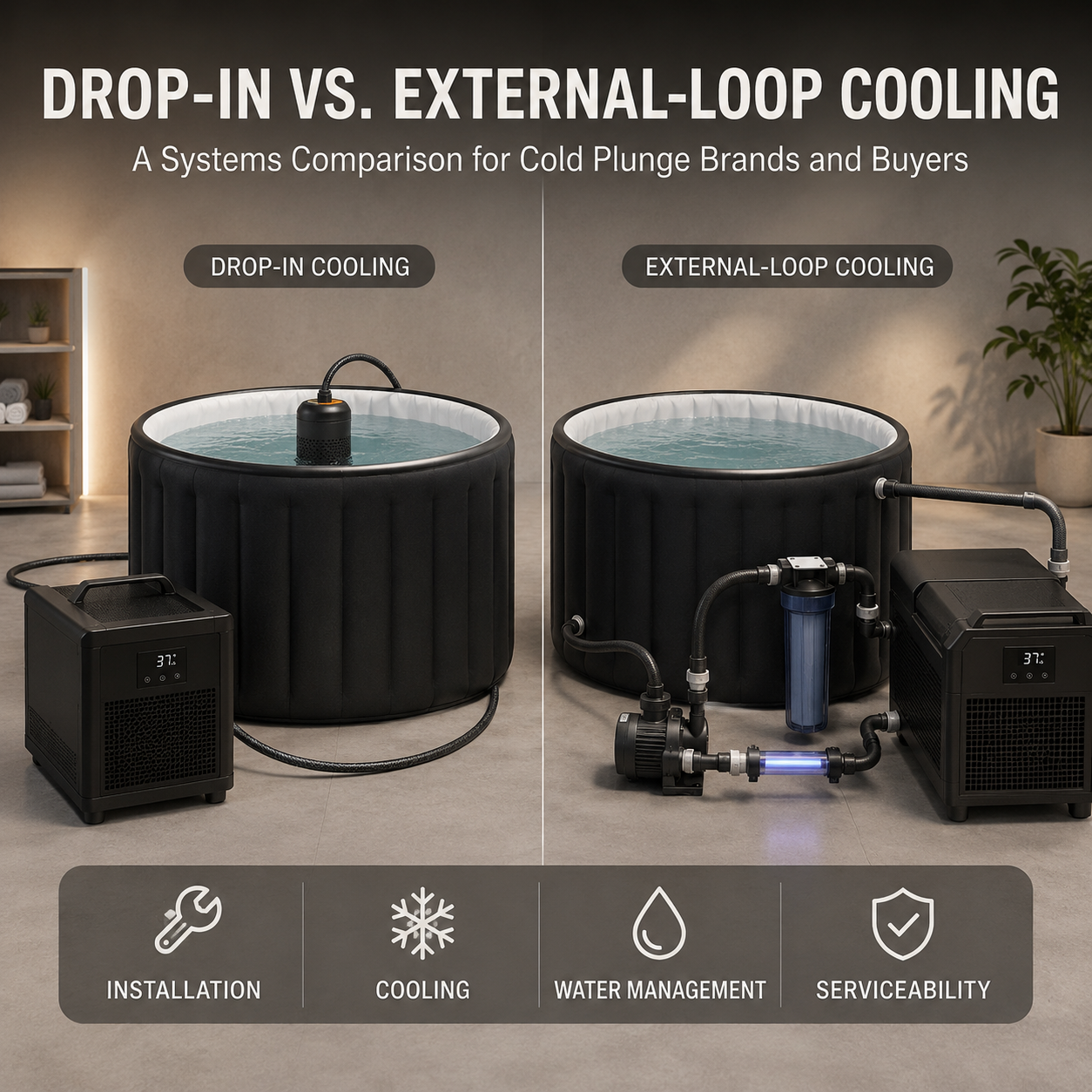
  1. Drop-in cooling, in which the cold-side cooling component is placed directly into the water and the tub does not require a conventional external plumbing loop.
  2. External-loop cooling, in which water leaves the tub, passes through a pump, chiller and optional treatment components, and then returns to the tub.

Both approaches can support effective cold-water systems. Neither is automatically superior in every application.

The correct choice depends on what the product is expected to do, who will maintain it, how often it will be used and how much installation complexity the end user will accept.

Executive Summary

For readers who need the main conclusions first:

  • Drop-in systems generally prioritize easy installation, broad tub compatibility and fewer external water connections.
  • External-loop systems generally provide more control over circulation, filtration, water treatment and component-level servicing.
  • Cooling speed cannot be predicted from architecture or horsepower alone.
  • Water temperature uniformity must be tested; it should not be assumed.
  • Cooling, filtration and disinfection are separate functions.
  • Fewer components can reduce some installation errors, but a highly integrated product may be more difficult to repair at component level.
  • More components create more possible connection and maintenance points, but they may also make individual parts easier to replace.
  • Residential, commercial and public-use products should not necessarily use the same architecture.
  • Brands should compare matched test data rather than relying on claims such as “no plumbing,” “all-in-one” or “higher horsepower.”

Scope and Methodology

This white paper provides an architecture-level engineering comparison. It does not claim that every drop-in chiller or every external-loop chiller behaves in the same way.

Actual performance depends on:

  • Cooling capacity;
  • Tub volume;
  • Starting and target water temperatures;
  • Ambient conditions;
  • Insulation;
  • Water circulation;
  • Heat-exchanger design;
  • Control logic;
  • Product placement;
  • Usage frequency;
  • Maintenance condition.

The comparison draws on established refrigeration and water-treatment principles together with a review of the two product architectures.

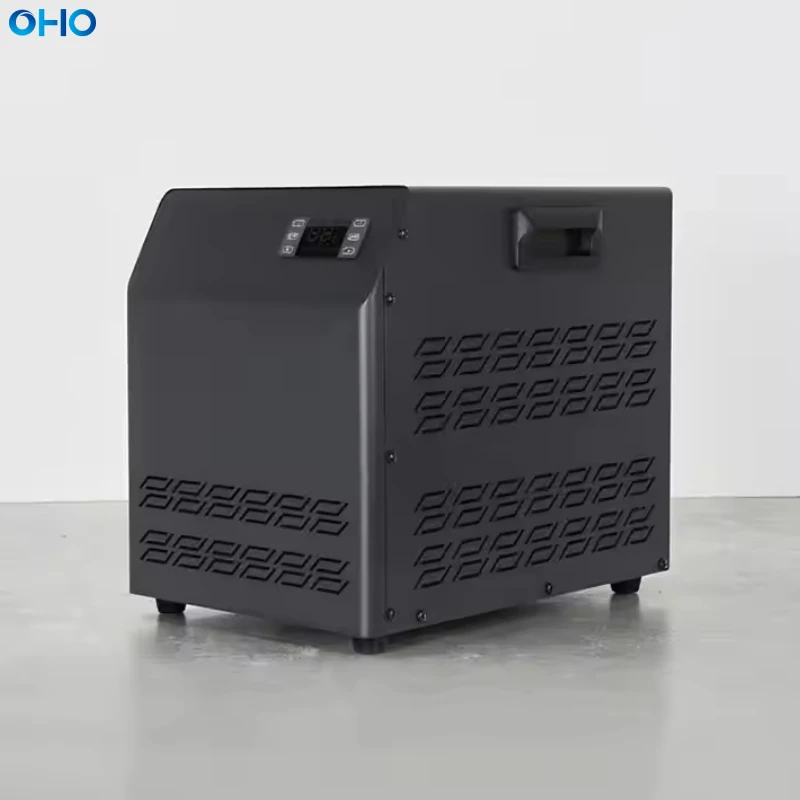
OHO’s current range illustrates both categories: its product pages include a no-pump, no-plumbing chiller designed to work without tub inlet and outlet ports, as well as external-loop models supplied with pumps, filters, hoses and optional UV or ozone functions.

1. Defining the Two Cooling Architectures

The terms “drop-in” and “external-loop” are useful product-development categories, but they are not universal technical standards. Individual products may combine features from both.

Drop-In Cooling

In a drop-in architecture, the cold-side heat-transfer component is placed directly in the tub water.

A typical system includes:

  • An external refrigeration unit;
  • A cooling element or assembly placed in the water;
  • Integrated refrigerant lines, electrical cables or protective conduits;
  • A temperature sensor and controller;
  • No conventional water inlet and outlet hoses running through the chiller.

Water remains inside the tub rather than being pumped through a separate chiller heat exchanger.

Some drop-in products may include internal water movement or optional accessories. Others depend more heavily on natural water movement and user activity. Therefore, “drop-in” should not automatically be interpreted as “no circulation of any kind.”

External-Loop Cooling

An external-loop architecture creates a defined water circuit:

Tub → suction line → pump → filter → chiller heat exchanger → optional water-treatment module → return line → tub

Depending on the system, the loop may include:

  • An external or built-in water pump;
  • Cartridge, mesh or reusable filtration;
  • UV equipment;
  • Ozone equipment;
  • Flow switches;
  • Bypass valves;
  • Quick connectors;
  • Insulated hoses;
  • Drain and priming points.

Water leaves the tub, is cooled and treated in external components, and then returns.

2. High-Level Comparison

Evaluation Area Drop-In System External-Loop System
Tub plumbing Usually no permanent tub ports required Requires inlet and return path
Initial setup Generally fewer hydraulic connections More hoses, fittings and priming steps
Tub compatibility Often works with a wider range of tubs Depends on ports, hoses or over-rim setup
Water circulation Product-dependent; must be validated Pump creates a defined water flow
Inline filtration Usually separate unless specifically integrated Easier to integrate into the loop
UV or ozone integration Usually separate or optional Commonly installed inline
External leak points Fewer water-side joints More hoses, seals and connections
In-tub hardware Cooling assembly occupies part of the tub Most active hardware remains outside
Component replacement Depends on modularity of integrated unit Pump, filter and hoses can often be replaced separately
Installation errors Fewer plumbing-related steps More risk of reversed hoses, air locks or restricted flow
Commercial water management May require additional modules More adaptable to complete treatment loops
Portability Strong when minimal setup is the priority Strong when packaged as a preassembled cart or module

This table describes typical tendencies, not guaranteed results.

3. Cooling Performance: Architecture Is Not Capacity

The presence or absence of hoses does not determine how much heat a system can remove.

The fundamental cooling task is the same:

  1. Absorb heat from the plunge water;
  2. Transfer that heat into the refrigerant;
  3. Reject the heat into the surrounding environment.

ASHRAE’s liquid-chiller test method defines cooling capacity from the liquid side using liquid mass flow and the change in energy between the inlet and outlet of the heat exchanger. In simplified water-side analysis, cooling transfer is commonly related to water flow, specific heat and the temperature difference across the cooling component.

However, the time required to cool a real plunge also depends on the total thermal load:

  • Water volume;
  • Initial water temperature;
  • Target water temperature;
  • Ambient air temperature;
  • Heat entering through the tub walls;
  • Heat entering through the exposed water surface;
  • Sunlight;
  • Ground contact;
  • Hoses and fittings;
  • Heat added by users;
  • Whether a cover is used.

Therefore, statements such as these are incomplete:

  • “External loops always cool faster.”
  • “Drop-in systems have zero cooling loss.”
  • “A 1 HP product cools twice as fast as a 0.5 HP product.”
  • “No hoses automatically means higher efficiency.”

Those conclusions require controlled test data.

4. Pull-Down Speed and Temperature Maintenance

Cooling performance has two separate tasks.

Pull-Down

Pull-down is the process of reducing water from its starting temperature to the target temperature.

For example:

25°C to 10°C

The result depends heavily on water volume and total heat gain.

Temperature Maintenance

Once the target is reached, the chiller must remove the heat that continues to enter the system.

Maintenance performance is affected by:

  • Ambient temperature;
  • Tub insulation;
  • Water-surface area;
  • Cover use;
  • User frequency;
  • Chiller control band;
  • Condenser airflow;
  • Pump and circulation conditions.

A system may have acceptable pull-down performance but struggle to maintain temperature outdoors in hot weather. Another may cool slowly from room temperature but maintain an already cold, well-insulated tub efficiently.

Brands should evaluate both tasks separately.

5. Water Circulation and Temperature Uniformity

A controller may show 5°C while some parts of the tub are warmer or colder.

The correct question is not only:

What does the sensor read?

It is:

How uniform is the water temperature throughout the occupied area?

External-Loop Circulation

An external-loop pump creates forced circulation.

If the inlet and return are positioned correctly, the system can:

  • Move warmer water toward the chiller;
  • Return cooled water into the tub;
  • Reduce temperature stratification;
  • Carry suspended material toward the filter;
  • Support inline UV or other treatment components.

However, advertised pump flow is not always the actual system flow.

Real flow can be reduced by:

  • Long hoses;
  • Small hose diameter;
  • Multiple elbows;
  • Restrictive connectors;
  • Dirty filters;
  • Elevation changes;
  • Kinked lines;
  • Air locks;
  • Partially closed valves;
  • Heat-exchanger pressure loss.

A large pump does not guarantee good circulation if the complete hydraulic loop is poorly designed.

Drop-In Heat Distribution

A drop-in cooling surface transfers heat directly to the surrounding water.

Its temperature distribution depends on:

  • Shape and area of the cooling element;
  • Position in the tub;
  • Distance from the tub walls;
  • Water depth;
  • Internal or natural water movement;
  • Whether the user blocks circulation;
  • Sensor location;
  • Any added mixing function.

A drop-in unit may create suitable uniformity in a compact tub but show stronger temperature differences in a large or unusually shaped tub.

This cannot be determined from product appearance alone.

Recommended Uniformity Test

Measure water at:

  • Top, middle and lower depths;
  • Near the cooling component;
  • At the opposite side of the tub;
  • Near the user’s torso and legs;
  • Before and after stirring;
  • Before and after a user session.

Report the maximum difference between relevant points during stable operation.

6. Installation and User Setup

Installation is one of the clearest differences between the two architectures.

Drop-In Installation

A typical drop-in setup may involve:

  1. Fill the tub;
  2. Position the cooling element according to the instructions;
  3. Secure cables or lines;
  4. Place the main unit with adequate ventilation;
  5. Connect power;
  6. Set the target temperature.

There may be no requirement to:

  • Cut holes in the tub;
  • Install inlet or outlet fittings;
  • Connect a water pump;
  • Prime an external loop;
  • Confirm water-flow direction.

This makes drop-in architecture attractive for:

  • First-time cold plunge users;
  • Existing tubs without ports;
  • Pop-up recovery spaces;
  • Rental or event applications;
  • Brands prioritizing low-friction setup.

OHO’s current drop-in product is presented as working without traditional pump plumbing or tub inlet and outlet ports.

External-Loop Installation

A typical external-loop setup may require:

  1. Connect the tub outlet to the pump or chiller inlet;
  2. Connect the cooled-water return;
  3. Install or check the filter;
  4. Confirm hose direction;
  5. Open all valves;
  6. Prime the pump;
  7. Remove trapped air;
  8. Check for leaks;
  9. Confirm flow before enabling cooling.

An integrated kit can simplify this process. OHO, for example, lists an external-loop package containing a filter, pump, insulated hoses and operating instructions.

However, the user must still understand the water path.

Clear labels, keyed connectors and setup videos can significantly reduce installation errors.

7. Tub Compatibility and Product Freedom

Drop-In Compatibility

Because a drop-in product does not necessarily need tub ports, it can often be paired with:

  • Drop-stitch tubs;
  • PVC frame tubs;
  • Rigid plastic tubs;
  • Metal tubs;
  • Existing bathtubs;
  • Prototype tubs;
  • Irregularly shaped products.

Compatibility still depends on:

  • Water volume;
  • Minimum water depth;
  • Available internal space;
  • Cooling-element clearance;
  • Tub material;
  • Safe cable routing;
  • Product instructions.

“Works with any tub” should therefore be understood as broad architectural compatibility—not as proof that every tub volume and environment will reach the same temperature.

External-Loop Compatibility

An external system needs a reliable suction and return path.

This can be achieved through:

  • Factory-installed tub ports;
  • Retrofit fittings;
  • Over-rim hoses;
  • A submersible pump;
  • A dedicated equipment connection panel.

For a complete branded system, factory-designed ports usually create a cleaner and more controlled installation.

For a chiller sold separately to fit many third-party tubs, adapters and hose compatibility become more important.

8. Cooling Is Not Filtration

One of the most important distinctions in cold plunge product design is:

A chiller cools water. It does not automatically clean the water.

Three functions should be evaluated separately:

Recirculation

Moves water through the system.

Filtration

Removes suspended particles according to the capability of the filter.

Disinfection or Microbial Control

Uses an appropriate chemical or physical process to control microorganisms.

The CDC Model Aquatic Health Code treats recirculation, filtration and disinfection as distinct elements of aquatic water management. Although the MAHC is designed primarily for public aquatic venues rather than personal residential plunges, the distinction is still useful when evaluating product architecture.

External-Loop Advantage

An external water path provides a convenient location for:

  • Filters;
  • UV reactors;
  • Ozone injection;
  • Chemical dosing equipment;
  • Flow meters;
  • Sampling points.

This does not mean every external-loop chiller includes an adequate water-treatment system.

The effectiveness depends on:

  • Actual flow rate;
  • Filter condition;
  • Treatment-system sizing;
  • Water quality;
  • Usage load;
  • Maintenance.

Drop-In Consideration

A drop-in cooling product may need a separate water-management strategy, such as:

  • Independent circulation filter;
  • Periodic water replacement;
  • Manual cleaning;
  • Tub cover;
  • Pre-use showering;
  • Approved residential water-treatment products;
  • A separate treatment module.

This should not be treated as a defect. It is a system-design choice.

The important point is that the brand clearly explains which functions are included and which are not.

9. UV Is Not a Standalone Guarantee

Many cold plunge products use phrases such as:

  • UV sanitation;
  • UV sterilization;
  • UV purification.

These phrases should be used carefully.

Effective UV treatment depends on delivered dose, which is influenced by:

  • UV intensity;
  • Exposure time;
  • Flow rate;
  • Water transmittance;
  • Lamp condition;
  • Sleeve fouling;
  • Reactor geometry.

EPA guidance for validated UV systems emphasizes operation within defined ranges for flow, UV intensity and water transmittance. A lamp’s presence alone does not prove a specific disinfection result.

For cold plunge products, brands should ask:

  • What UV wavelength is used?
  • What is the rated lamp output?
  • What flow range is specified?
  • Is the lamp located inline or simply near the water?
  • How is lamp status monitored?
  • How is the sleeve cleaned?
  • Is there any validation for the claimed function?
  • What additional water-care steps remain necessary?

A UV module can be one part of a water-management strategy. It should not be presented as a substitute for filtration, cleaning and appropriate operating procedures.

10. Maintenance Requirements

Both architectures require maintenance, but the work is different.

Typical Drop-In Maintenance

May include:

  • Cleaning the immersed cooling surface;
  • Removing mineral or organic deposits;
  • Inspecting protective guards;
  • Checking cables and integrated lines;
  • Ensuring the component remains correctly positioned;
  • Keeping the condenser air path clear;
  • Drying and cleaning the unit before storage;
  • Inspecting the tub for damage caused by contact or movement.

The exact method must follow the product instructions. Abrasive tools or inappropriate chemicals can damage heat-transfer surfaces or protective coatings.

Typical External-Loop Maintenance

May include:

  • Cleaning or replacing filters;
  • Inspecting hose seals;
  • Tightening or replacing connectors;
  • Removing air from the loop;
  • Cleaning the pump strainer;
  • Checking actual water flow;
  • Inspecting the UV sleeve or ozone system;
  • Draining the loop before freezing conditions;
  • Checking for slow leaks;
  • Cleaning the chiller heat exchanger according to instructions.

External-loop maintenance is usually more visible and distributed across more components.

Drop-in maintenance may involve fewer water-side components but greater dependence on the condition of one integrated cooling assembly.

11. Failure Points and Troubleshooting

Common Drop-In Risks

Depending on the design:

  • Incorrect placement;
  • Restricted water movement around the cooling surface;
  • Fouling on the immersed component;
  • Sensor placement that does not represent average water temperature;
  • Physical contact with the tub wall or user;
  • Damage to integrated cables or lines;
  • Inadequate condenser ventilation;
  • Insufficient capacity for the tub or climate.

Common External-Loop Risks

Depending on the design:

  • Clogged filter;
  • Kinked hose;
  • Air lock;
  • Reversed inlet and outlet;
  • Pump losing prime;
  • Low actual flow;
  • Flow-switch fault;
  • Connector leakage;
  • Damaged seal;
  • Improper valve position;
  • Inadequate winter drainage.

Risks Shared by Both

  • Undersized cooling capacity;
  • High ambient heat;
  • Direct sun;
  • Poor tub insulation;
  • Incorrect power supply;
  • Blocked condenser airflow;
  • Dirty heat-transfer surfaces;
  • Incorrect temperature-sensor reading;
  • Poor control calibration;
  • Inadequate maintenance.

The architecture changes the failure map; it does not eliminate the need for engineering validation.

12. Repairability and After-Sales Cost

A product with fewer components is not automatically cheaper to support.

A product with more components is not automatically less reliable.

Drop-In After-Sales Model

Potential advantages:

  • Fewer plumbing questions;
  • Fewer external leak connections;
  • Easier remote setup guidance;
  • Fewer pump-priming issues;
  • Lower risk of hoses being installed backwards.

Potential limitations:

  • A highly integrated sealed assembly may not be repairable in the field;
  • Damage to one integrated line can affect the complete module;
  • Replacement may require shipping a larger assembly;
  • Local technicians may be unfamiliar with the design.

External-Loop After-Sales Model

Potential advantages:

  • Pump, hose, filter and fittings may be replaced separately;
  • Common hydraulic faults can often be diagnosed remotely;
  • Modular parts can be stocked as service kits;
  • The chiller can sometimes remain in use after replacing a low-cost component.

Potential limitations:

  • More components create more diagnostic branches;
  • Users may install the system incorrectly;
  • Slow leaks may be difficult to locate;
  • Filter maintenance can be neglected;
  • Third-party replacement parts may change flow or performance.

Brands should evaluate service architecture, not only product architecture.

A useful service plan may include:

  • Exploded parts diagram;
  • Error-code guide;
  • Setup video;
  • Flow troubleshooting;
  • Leak-check procedure;
  • Replaceable-module list;
  • Spare-part numbers;
  • Technician instructions;
  • Warranty decision tree.

13. Noise, Vibration and Placement

Both architectures can use compressors, fans and controls that create sound.

Noise is influenced more by the complete product design than by the water-loop category alone.

Relevant factors include:

  • Compressor type;
  • Fan speed;
  • Pump noise;
  • Structural vibration;
  • Floor material;
  • Distance from walls;
  • Ventilation clearance;
  • Operating stage;
  • Start-stop control;
  • Outdoor versus indoor placement.

An external-loop system may allow the main chiller to be positioned farther from the tub, within the permitted hydraulic limits.

A drop-in unit may reduce pump noise if no separate water pump is used, but the refrigeration unit may still be positioned near the tub because of the integrated connection length.

Noise claims should therefore state:

  • Measurement distance;
  • Operating mode;
  • Background noise;
  • Whether the pump and compressor were running;
  • Test environment.

14. Condensation and Wet-Area Management

Any surface colder than the surrounding air’s dew point can develop condensation.

Potential locations include:

  • Cooling elements;
  • Hoses;
  • Metal fittings;
  • Heat exchangers;
  • Tub walls;
  • Return lines.

Drop-In Systems

The cold element is already in water, but integrated lines and nearby surfaces may still produce condensation.

The design should consider:

  • Drip routing;
  • Cable protection;
  • Floor protection;
  • Safe removal;
  • Storage after use.

External-Loop Systems

Cold hoses and fittings can sweat outside the tub.

Useful controls include:

  • Insulated hoses;
  • Sealed insulation joints;
  • Drip trays;
  • Water-resistant floors;
  • Separation from electrical connections;
  • Adequate ventilation.

Condensation should be evaluated during long-duration operation under warm, humid conditions—not only during a short showroom demonstration.

15. Best-Fit Application Scenarios

Apartment or Small Home

A drop-in architecture may be attractive when:

  • The user wants minimal setup;
  • The tub has no ports;
  • Equipment must be moved or stored;
  • There is limited confidence with pumps and hoses;
  • Water is changed relatively frequently.

An external-loop system may still be preferable when the user wants integrated filtration and less frequent water replacement.

Premium Residential Product

Either architecture can work.

A drop-in product can support a clean, minimal installation story.

An external loop can support:

  • Continuous circulation;
  • Concealed filtration;
  • Integrated treatment;
  • More advanced control;
  • A complete tub-and-chiller ecosystem.

Gym or Recovery Studio

External-loop systems are often easier to develop into a complete water-management platform because circulation and treatment components can be integrated.

However, the design must reflect:

  • Number of users;
  • Local health requirements;
  • Cleaning procedures;
  • Water-testing procedures;
  • Operator training;
  • Required redundancy.

A residential cold plunge should not automatically be repurposed for public or high-throughput use.

Mobile Event or Pop-Up Recovery

Drop-in architecture can be useful where:

  • Speed of installation matters;
  • Tub ports are undesirable;
  • Equipment changes location frequently;
  • Plumbing experience is limited;
  • Water is drained after the event.

Chiller Sold Separately

Drop-in architecture may offer wider tub compatibility.

External-loop products can also serve multiple tubs, but they need:

  • Adapters;
  • Compatible ports;
  • Clear hose specifications;
  • Defined minimum flow;
  • Installation guidance.

Complete DTC Product System

External-loop architecture gives the brand more control over the entire tub, pump, hose, filtration and treatment package.

Drop-in architecture can reduce initial consumer friction and make the brand promise easier to communicate:

Add water, position the cooling component and set the temperature.

The best architecture depends on the intended brand experience.

16. Buyer Decision Matrix

Buyer Priority Architecture Usually Worth Evaluating First
Fastest and simplest setup Drop-in
Works with tubs without ports Drop-in
Minimal external hoses Drop-in
Integrated filtration External loop
Inline UV or ozone External loop
High-use commercial water circulation External loop
Component-level pump and filter replacement External loop
Pop-up and mobile use Drop-in
Complete premium tub ecosystem External loop or integrated hybrid
Low consumer installation knowledge Drop-in
Brand wants control over every system component External loop
Water changed after each event Drop-in
Long-term water-management program External loop

This matrix is a starting point, not a substitute for product testing.

17. A Fair Comparison Test Protocol

Brands should compare the architectures under matched conditions.

Test Conditions

Use the same:

  • Tub;
  • Water volume;
  • Starting temperature;
  • Target temperature;
  • Ambient temperature;
  • Humidity;
  • Power supply;
  • Cover condition;
  • Indoor or outdoor location;
  • Test duration.

Cooling Performance

Record:

  • Time to selected temperature points;
  • Time to target temperature;
  • Minimum water temperature;
  • Stable control range;
  • Power consumption;
  • Compressor duty cycle;
  • Recovery after a user session.

Temperature Uniformity

Measure:

  • Top, middle and lower water levels;
  • Near and far from the cooling component;
  • Before and after mixing;
  • During stable operation;
  • After a user exits.

External-Loop Hydraulics

Record:

  • Actual flow rate;
  • Pump power;
  • Pressure or restriction where applicable;
  • Clean-filter flow;
  • Partially loaded-filter flow;
  • Response to hose kinking or air entry;
  • Priming time.

Water Management

Evaluate separately:

  • Particle removal;
  • Filter maintenance;
  • UV or ozone operating conditions;
  • Cleaning requirements;
  • Water-change schedule;
  • Treatment-system documentation.

Installation

Record:

  • Number of setup steps;
  • Setup time;
  • Tools required;
  • Number of possible incorrect connections;
  • Leak-check time;
  • Training or video required.

Reliability and Service

Test:

  • Repeated assembly;
  • Connection cycles;
  • Hose bending;
  • Pump restart;
  • Filter loading;
  • Cooling-element cleaning;
  • Cable and line movement;
  • Transport and storage;
  • Replaceable components.

Without this matched protocol, a comparison can easily favour one architecture simply because it was tested under easier conditions.

18. What Brands Should Ask Suppliers

Before selecting a system, ask:

  1. What exactly is included in the cooling architecture?
  2. Does water leave the tub?
  3. Is a pump required?
  4. What is the measured cooling capacity under defined conditions?
  5. Which tub volumes and ambient temperatures were tested?
  6. How uniform is water temperature at different locations?
  7. For an external loop, what is the required and measured flow range?
  8. What happens if the filter becomes restricted?
  9. Does the product include filtration, disinfection, both or neither?
  10. What evidence supports any UV or ozone claim?
  11. Which parts are replaceable?
  12. Can the user replace the pump, filter, hoses or cooling module?
  13. How is condensation controlled?
  14. What installation errors are anticipated?
  15. What safety and compliance evaluations apply to the final configuration?
  16. Is the quoted performance based on one sample or several production units?

The quality of the answers is often more informative than the size of the compressor.

19. Limitations of This Comparison

This paper compares system principles rather than individual models.

It does not establish that:

  • Every drop-in system is easier to use;
  • Every external-loop system filters water effectively;
  • One architecture always cools faster;
  • One architecture always uses less energy;
  • One architecture is inherently safer;
  • Any UV or ozone accessory guarantees water sanitation.

Product-level conclusions require:

  • Controlled test data;
  • Final product specifications;
  • Applicable safety evaluation;
  • Water-treatment validation where claims are made;
  • Review of target-market requirements.

Public or commercial cold plunges may also be subject to local health, construction, electrical and water-treatment requirements that do not apply to personal residential products.

Conclusion: Choose a System, Not Just a Chiller

Drop-in and external-loop cold plunge chillers represent two different approaches to the same task.

A drop-in architecture can reduce plumbing, simplify tub compatibility and make initial setup easier.

An external-loop architecture can provide more control over circulation, filtration, water treatment and component-level maintenance.

But the choice should not be based on a single slogan.

The better system is the one that matches:

  • The target user;
  • The target tub;
  • The climate;
  • The required cooling performance;
  • The water-management plan;
  • The expected usage frequency;
  • The service network;
  • The brand’s product promise.

For buyers, the most useful question is not:

Which architecture is better?

It is:

Which architecture creates the fewest compromises for this specific product and user?

Develop the Right Cold Plunge Cooling Architecture

OHO currently develops both no-traditional-plumbing cold plunge chillers and external-loop systems with pumps, filters, hoses and optional water-treatment functions.

A new product program can be defined around:

  • Target tub volume;
  • Indoor or outdoor use;
  • Desired pull-down time;
  • Target temperature;
  • Drop-in or external-loop architecture;
  • Filtration and water-treatment needs;
  • Residential or commercial positioning;
  • Noise and condensation targets;
  • Installation experience;
  • Maintenance model;
  • Replaceable components;
  • Destination-market requirements.

Contact OHO to discuss a cold plunge system designed around the complete user and service experience—not only the chiller specification.

Frequently Asked Questions

Which system cools water faster?

Architecture alone does not determine cooling speed. Cooling capacity, water volume, starting temperature, ambient conditions, insulation and water mixing must all be tested.

Does a drop-in chiller need a water pump?

Not necessarily. Some are designed without a conventional external water pump. Other designs may include internal circulation or use an optional mixing accessory.

Does a drop-in chiller filter the water?

Not automatically. Cooling and filtration are separate functions unless the product includes a defined filtration module.

Is an external-loop system always cleaner?

No. It provides a convenient architecture for filtration and treatment, but those components must be correctly sized, operated and maintained.

Can a drop-in chiller work with any tub?

It may offer broader compatibility because tub ports are not always required. However, tub volume, water depth, cooling-element clearance, material and operating conditions still matter.

Which system has fewer leaks?

Drop-in systems generally have fewer external water-side connections. External-loop systems can still be leak-resistant when fittings, hoses and installation are properly designed.

Which system is easier to repair?

External-loop systems often allow pumps, filters and hoses to be replaced separately. Drop-in serviceability depends on whether the integrated cooling assembly is modular or sealed.

Is UV enough to keep cold plunge water safe?

UV can be one part of water management, but its performance depends on validated operating conditions. It does not replace filtration, cleaning and other appropriate water-care practices.

Which architecture is better for a gym?

An external loop often provides more options for continuous circulation and water-treatment integration. The final system must still be designed for user volume and applicable local requirements.

Which architecture is better for a portable event setup?

Drop-in architecture is often attractive when rapid setup, broad tub compatibility and minimal plumbing are priorities.

Prev

From Single Modality to Recovery Circuit: Engineering Portable Heat-and-Cold Systems for Modern Wellness Spaces

ALL

Beyond Maximum Temperature: How to Evaluate Real Portable Sauna Performance

Next
Recommended Products
drop in vs external loop cold plunge cooling-0

Get a Free Quote

Our representative will contact you soon.
Email
Name
Company Name
Mobile
WeChat ID
WhatsApp
Files
Message
0/1000