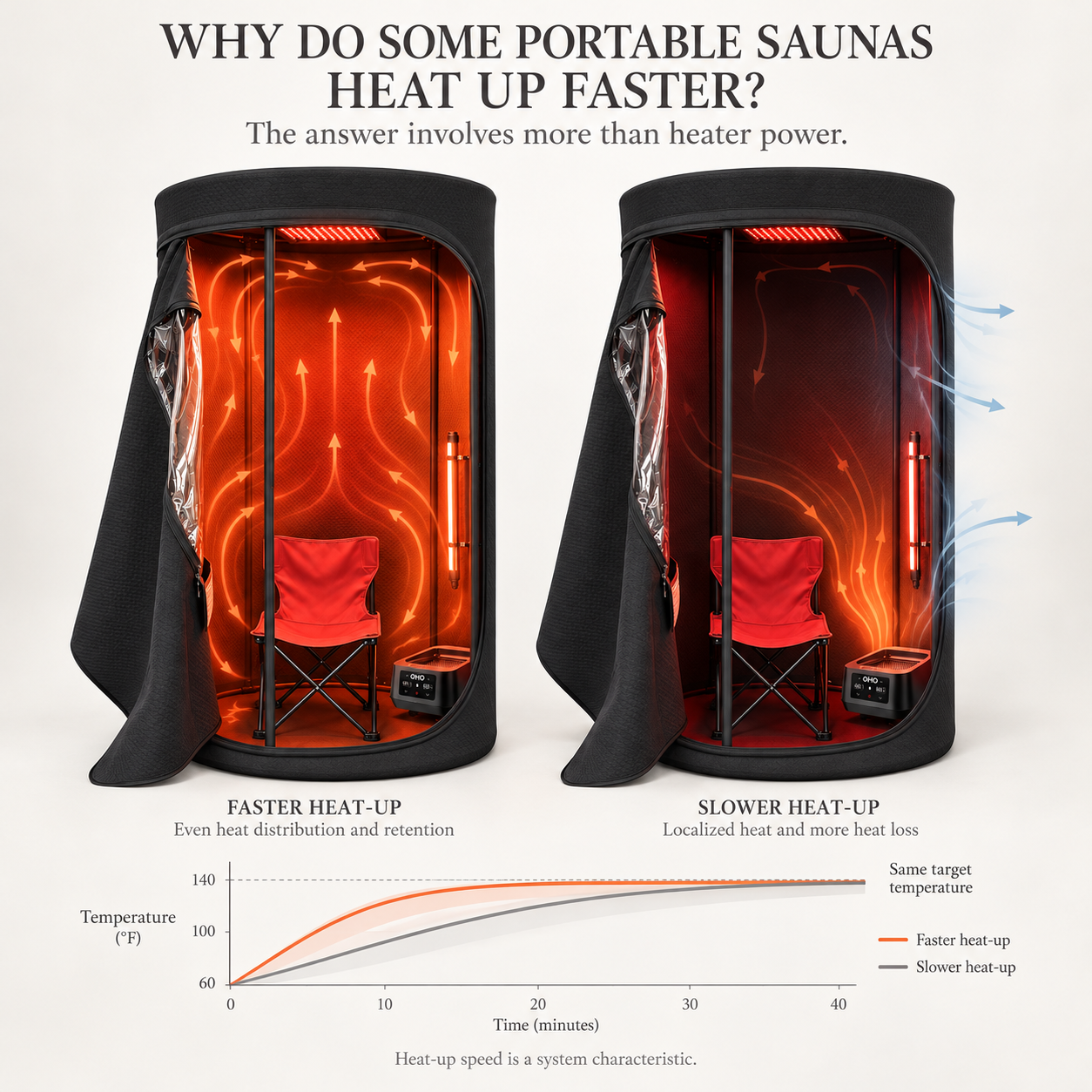
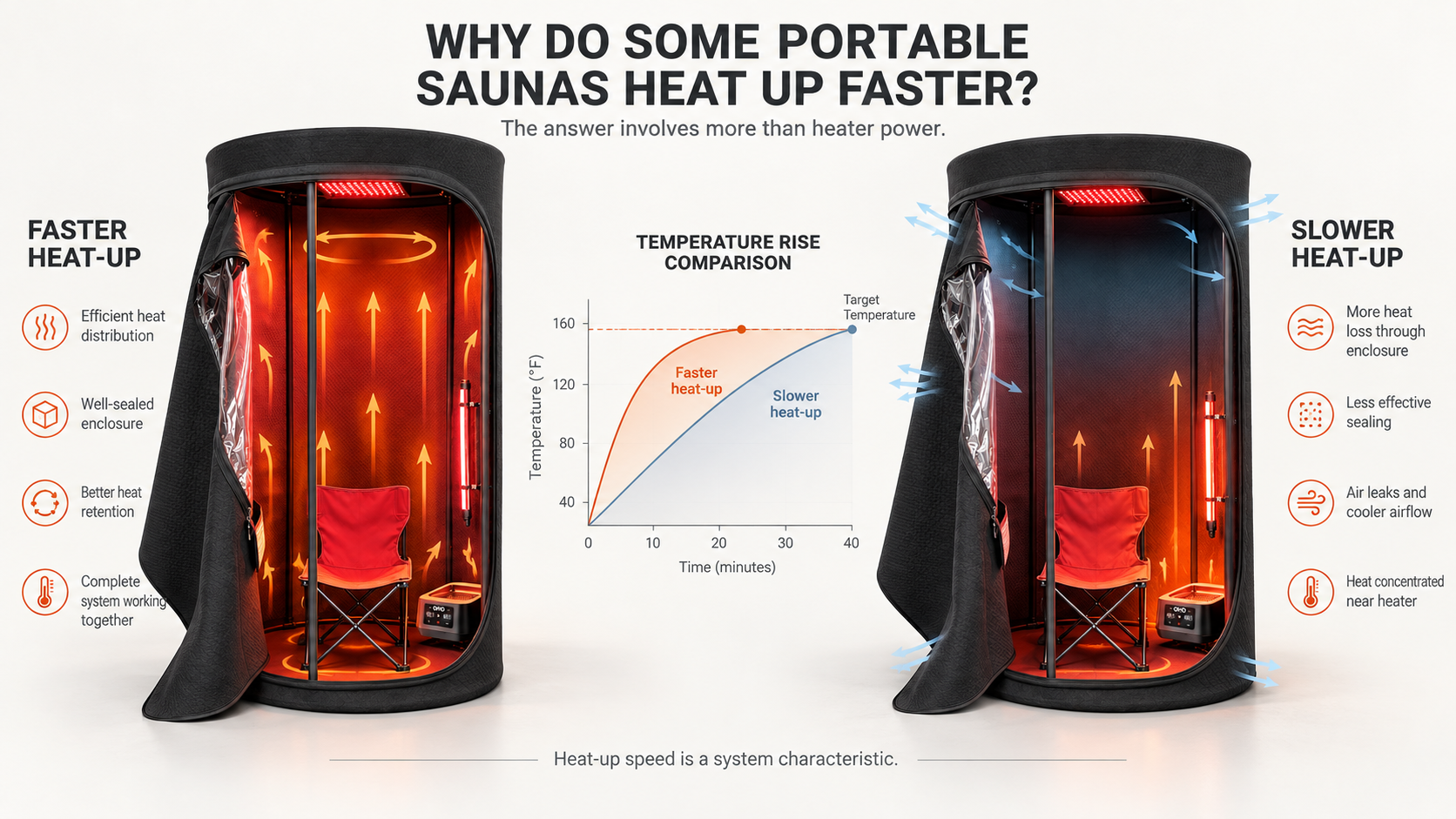
Two portable saunas can use similar heater power and still heat up at very different speeds.
One may reach a useful operating temperature relatively quickly. Another may take noticeably longer, even though the heater specifications look almost identical on paper.
So what is actually causing the difference?
The answer is rarely just the heater.
For a hot-air portable sauna, heat-up time is the result of several things working together: heater output, enclosure size, insulation, air leakage, starting temperature, airflow, internal materials and how temperature is measured.
In simple terms, a sauna heats quickly when it can put useful heat into the enclosure faster than that heat is being lost.
That sounds straightforward. In practice, the details matter.
Heat-up speed is a system characteristic — not simply a heater specification.
Note: This article focuses primarily on hot-air portable sauna tents. Far infrared saunas use a different heat-transfer mechanism and should be evaluated using additional criteria beyond air temperature.
The first specification most people look at is heater wattage.
That makes sense. A heater with more available output has greater potential to add heat to the enclosure.
But comparing wattage by itself can be misleading.
Imagine two portable saunas using heaters with the same nominal power.
If Sauna A has a compact, well-sealed enclosure while Sauna B has more heat loss through its shell, seams, window and openings, the two systems may not heat at the same rate.
The important relationship is not simply:
More watts = faster heating
It is closer to:
Useful heater output − heat loss = net heat available for warming the system
This is why heater power needs to be considered together with enclosure volume and thermal design.
Sauna modelling also shows that heating behaviour depends on multiple interacting variables, including heater power, enclosure dimensions, material properties, airflow and surrounding temperature. COMSOL
A larger heater can help, but it cannot compensate indefinitely for a poorly designed thermal envelope.
A portable sauna may look simple from the outside: fabric, frame, zipper, window and heater.
Thermally, however, every one of those components matters.
Once the inside becomes much hotter than the room around it, heat naturally moves toward the cooler environment. Heat can leave through the enclosure itself, but also through seams, gaps, doors, windows and other openings.
This is why insulation and air sealing matter.
The U.S. Department of Energy notes that heat flow through an enclosure is affected by insulation as well as gaps and air leakage; imperfections in the thermal boundary can reduce its real-world effectiveness. Building Science Education
For a portable sauna, the practical question is therefore not simply:
How thick is the insulation?
It is:
How effectively does the complete enclosure retain the heat being produced?
A well-designed enclosure should balance:
Adding more material is not automatically the answer. The goal is a balanced enclosure that retains useful heat without making the product unnecessarily heavy, bulky or difficult to store.
A portable sauna does not always start from the same place.
A unit starting in a warm indoor room has a different thermal challenge from one starting in a cool garage, basement or room with strong air conditioning.
If the starting temperature is lower, the system has a larger temperature difference to overcome.
And as the inside of the sauna becomes hotter, the temperature difference between the enclosure and its surroundings becomes larger as well. That increases the potential for heat loss through the enclosure.
This is one reason a heat-up time measured under one set of conditions should not automatically be treated as a universal number.
A useful test report should therefore record at least:
The surrounding environment is not just background information.
It is part of the test.
This is one of the more interesting parts of the equation.
A hot-air heater does not just add heat. It also creates an airflow pattern.
Hot air naturally rises, while cooler air moves downward. Heater position, outlet direction, enclosure geometry and ventilation can all influence how heat travels through the space. Sauna modelling treats airflow and heat transfer together for exactly this reason. COMSOL
Imagine a heater that sends most of its hot air directly toward the upper part of the enclosure.
A temperature sensor located nearby may rise quickly.
But that does not necessarily mean the entire user zone has warmed equally quickly.
You could end up with:
Fast sensor response → slow overall heat distribution
This is an important distinction.
A good heating system should not only move heat quickly. It should move heat where it is needed.
For a seated portable sauna, that may mean paying attention to:
The objective is not to make every point identical.
The objective is to avoid a situation where the temperature reading looks impressive while important user zones are still catching up.
Here is a detail that is easy to overlook.
When a portable sauna starts from room temperature, the heater is not only heating the air.
It is also transferring heat to the materials inside the enclosure.
Depending on the design, this can include:
These materials absorb thermal energy as their temperature rises.
This is known as thermal mass.
In a lightweight portable sauna, the effect is generally smaller than in a traditional wood sauna filled with heavy benches and stones. But it is still part of the heating process.
Thermal mass affects how quickly a space warms and cools because some of the energy entering the space is stored in the materials rather than immediately appearing as a rise in air temperature. gov.uk
This helps explain an interesting situation:
The display says the sauna has reached the target temperature — but the space may still feel as though it is warming up.
The air has reached the number.
The rest of the system is still catching up.
This is where a simple question becomes surprisingly complicated:
When exactly has a sauna “heated up”?
Is it when:
These are not necessarily the same moment.
A sensor near the heater may respond differently from one positioned at seated head height.
A sensor near the ceiling may reach the target earlier than one near the legs.
For this reason, a meaningful heat-up test needs a clearly defined measurement point and method. ISO 7726:2025, for example, establishes characteristics and methods for instruments used to measure physical quantities in thermal environments. It is not a portable-sauna performance standard, but it reinforces the importance of defined measurement methods. ISO
This is also why two brands can publish different “heat-up times” without necessarily testing the same thing.
The number alone is not enough.
A portable sauna is not a sealed laboratory chamber.
Someone has to get inside.
The door opens. Warm air leaves. Cooler air enters.
The heater then has to rebuild the lost thermal condition.
The same principle applies to ventilation.
Ventilation can be necessary for the intended product design and user environment, but every opening changes the movement of air and therefore affects the thermal balance.
This creates another useful performance metric:
How quickly does the sauna recover after heat is lost?
A product that heats quickly but loses a large amount of heat every time the door opens may not feel as responsive in actual use as its initial heat-up number suggests.
That is why heat-up time and recovery time should be considered together.
It sounds logical:
Smaller space → less air → faster heating.
There is some truth in that, but it is incomplete.
A smaller enclosure may require less energy to raise its air temperature, but its performance still depends on how much heat escapes.
Consider two compact portable saunas:
Sauna B may still take longer to reach a useful and stable operating condition.
This is the bigger lesson:
Volume influences heat-up. It does not determine it by itself.
The same principle appears throughout thermal engineering: system geometry, materials, heat loss and heating capacity interact rather than operating as isolated specifications. COMSOL
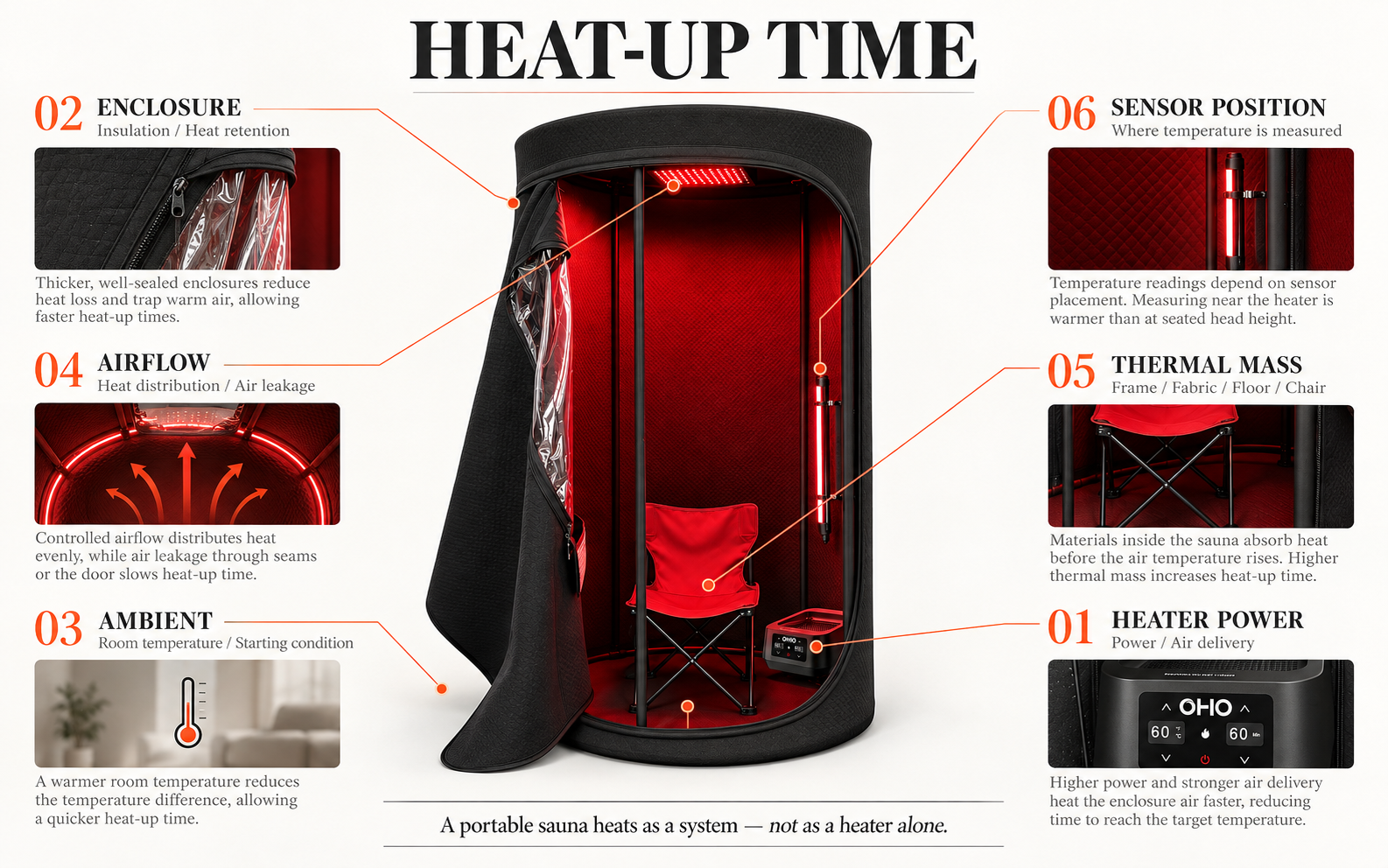
The simplest way to look at it is as a balance.
| Factor | What it influences |
|---|---|
| Heater output | How much heat can be added |
| Enclosure volume | How much space must be warmed |
| Insulation | How much heat is retained |
| Air leakage | How much warm air escapes |
| Ambient temperature | Starting thermal condition |
| Airflow | Where the heat travels |
| Internal materials | How much energy is stored |
| Sensor location | When the target appears to be reached |
| Door / ventilation | Heat loss during operation |
| Control system | How heating is regulated |
No single factor wins every time.
A strong portable sauna is the result of these elements being designed to work together.
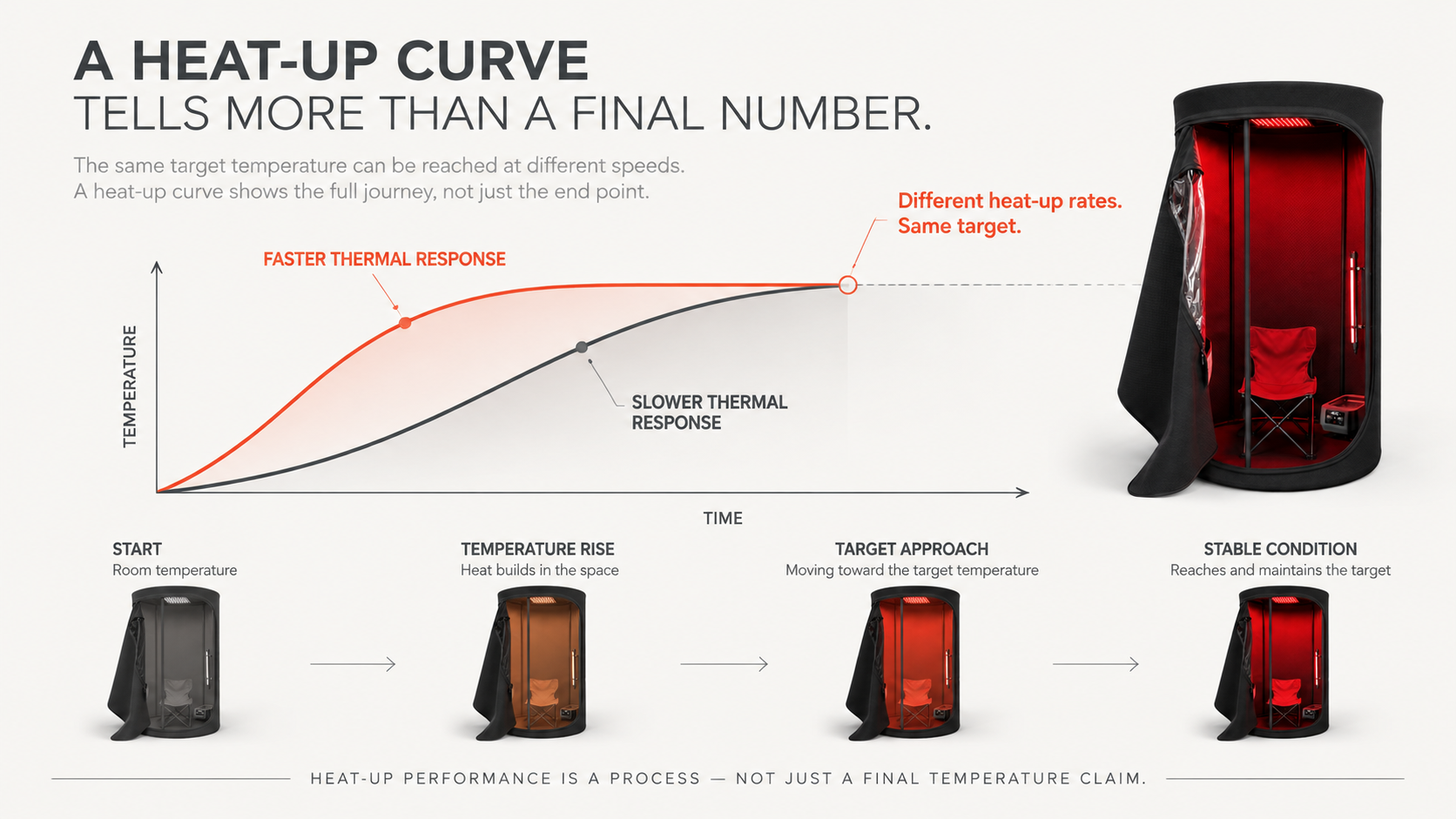
If you are comparing two portable saunas, avoid asking only:
How many minutes does it take to reach 85°C?
Ask a few more questions.
A test starting at 23°C is not directly comparable with one starting at 10°C.
Ceiling, torso, head, leg or heater-side readings can produce different results.
An empty enclosure provides useful baseline information, but it does not represent every aspect of actual use.
Was it a momentary peak, a displayed setpoint or a stable operating condition?
A smooth, stable curve tells a different story from a fast rise followed by large fluctuations.
This is often much closer to real-world use than an untouched laboratory setup.
These questions turn a simple number into useful performance information.
For a more complete framework for evaluating portable sauna performance, see OHO's related article:
Beyond Maximum Temperature: How to Evaluate Real Portable Sauna Performance
For product developers and brands, heat-up speed should ideally be treated as a design target rather than something measured only after the prototype is finished.
A useful development process can start with:
Define the target
What temperature range and heat-up experience is actually intended?
↓
Match the heater
Select appropriate heating output for the enclosure and intended market.
↓
Design the enclosure
Consider insulation, seams, openings, windows and floor construction.
↓
Design the airflow
Determine where hot air enters and how it moves through the user zone.
↓
Define measurement points
Decide where temperature will be measured and how the test will be repeated.
↓
Test the complete system
Record the heat-up curve, temperature distribution and stable operating condition.
↓
Repeat across units
A good prototype is useful. Consistent production performance is better.
The goal is not simply to make the temperature number rise quickly.
It is to make the whole thermal system respond predictably.
Why do some portable saunas heat up faster than others?
Because a portable sauna is more than a heater inside a fabric enclosure.
Its heat-up behaviour is shaped by the relationship between:
HEATER + ENCLOSURE + INSULATION + AIRFLOW + ENVIRONMENT + CONTROL + MEASUREMENT
A higher-power heater can increase heating capability.
Better insulation can reduce heat loss.
Better airflow can move heat more effectively.
A better enclosure can retain more of the energy being produced.
A better test method can tell you what is actually happening instead of simply producing a bigger number.
That is why two portable saunas with similar specifications can still deliver noticeably different heat-up performance.
The better question is not:
“Which sauna reaches the highest temperature?”
It is:
“How efficiently and consistently does the complete system create the intended thermal environment?”
That is where meaningful portable sauna performance begins.
At OHO, portable sauna development can involve more than selecting a heater and enclosure.
Performance targets can be considered alongside:
For brands developing or sourcing portable sauna products, the right starting point is not always a specification sheet.
Sometimes it is a better question:
What should the thermal experience actually feel like — and what needs to happen inside the product to create it?
There is no single heat-up time that applies to every portable sauna. The result depends on heater output, enclosure volume, insulation, starting ambient temperature, airflow, heat loss and how the target temperature is measured.
Not necessarily. Higher heater output can provide more heating capacity, but the result also depends on enclosure design, heat loss, airflow, temperature control and power supply conditions.
Possible factors include low ambient temperature, heat loss through the enclosure, air leakage, airflow configuration, sensor location, power-supply conditions or a problem with the heating or control system. A change in performance from a previously normal unit should be treated differently from a product that was simply designed with a longer heat-up time.
Because the temperature rating describes only one part of the system. Heater output, enclosure construction, insulation, airflow, sensor location, operating conditions and temperature stability can all change the actual heat-up experience.
Not necessarily. Faster heating can be useful, but it should be considered alongside temperature distribution, stability, heat retention and safe control. A very fast initial rise does not automatically mean better overall performance.

 EN