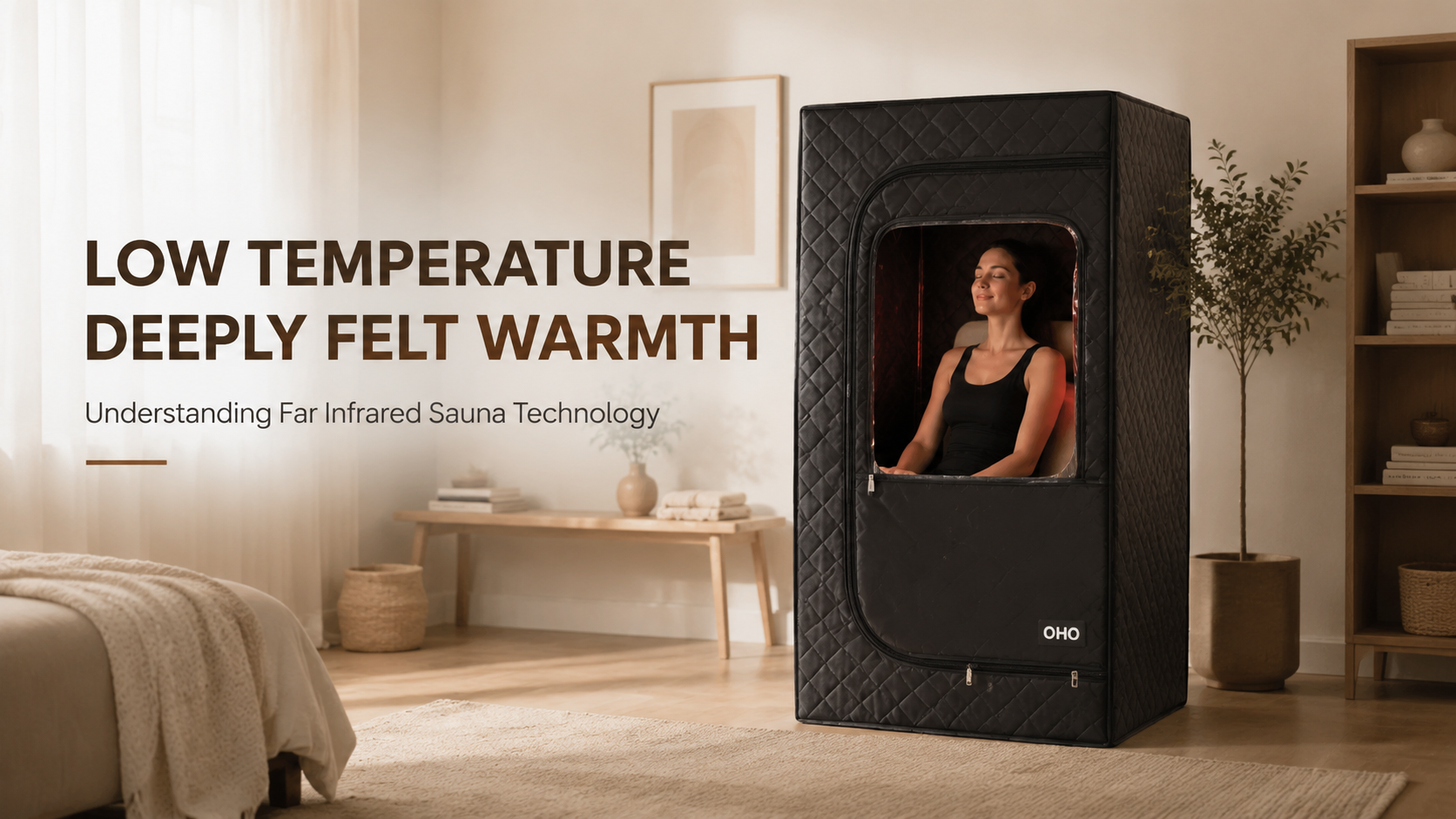
A traditional sauna is easy to understand: a heater raises the temperature of the air, and the hot air gradually warms the person inside.
A far infrared sauna works differently. Rather than depending primarily on very hot air, it uses heated emitters or panels to transfer a larger share of their energy to the user as infrared radiation. This makes it possible to create a strong sensation of warmth and stimulate normal heat-regulation responses at a lower air temperature.
That difference is the foundation of the infrared sauna experience. It is also the source of considerable confusion.
Terms such as “deep heat,” “infrared penetration” and “detoxification” are frequently used in consumer marketing, but they do not always describe the technology accurately. A responsible explanation must distinguish between:
Infrared radiation and hot air
Surface absorption and whole-body warming
A normal heat response and a proven medical outcome
Infrared emissions and electromagnetic fields from electrical components
A comfortable user experience and measurable product performance
This article explains the science behind far infrared sauna technology, the practical meaning of lower-temperature heating and the engineering factors that determine whether a portable infrared sauna performs consistently.
Infrared radiation is a form of electromagnetic energy located beyond visible red light on the electromagnetic spectrum. It is invisible to the human eye, but absorbed infrared energy can be experienced as heat.
Infrared is commonly divided into near-, middle- and far-infrared bands. However, the exact boundaries vary between scientific and technical classification systems. The International Commission on Non-Ionizing Radiation Protection, for example, describes IR-C or far-infrared as approximately 3 micrometers to 1 millimeter, while other standards place the beginning of the far-infrared band at a longer wavelength.
This variation matters for product marketing.
A product should not be judged only by the phrase “far infrared.” Brands developing an infrared sauna should also ask:
What type of heating element is used?
What surface temperature does the emitter reach?
Is the heater’s spectral output documented?
How much radiant energy reaches the seated user?
How evenly are the front, back, sides and lower body heated?
How is the temperature controlled under real operating conditions?
The infrared label describes part of the heating mechanism. It does not, by itself, prove heating uniformity, comfort, safety or therapeutic performance.
Heat can move through conduction, convection and radiation.
In a sauna, all three forms of heat transfer may be present, but their relative contribution changes according to the system.
A conventional sauna heater warms the surrounding air. The hot air circulates inside the cabin and transfers heat to the user mainly through convection, while hot surfaces also contribute radiant heat.
Traditional Finnish-style sauna environments commonly operate at high air temperatures, often around 80–100°C, although actual settings and humidity vary.
An infrared sauna uses electrically heated panels, films, carbon elements, ceramic emitters or other heating assemblies. When their temperature rises, the surfaces emit infrared radiation as part of their thermal energy.
That radiant energy travels through the enclosure and is absorbed primarily at the user’s skin and clothing. The absorbed energy becomes heat. Skin temperature rises, blood flow to the skin can increase, and the body may begin sweating as it works to control its internal temperature.
The enclosure air also becomes warmer, but very high air temperature is not the only mechanism delivering heat to the user.
This is why infrared saunas can produce a significant warming experience in environments that are cooler than many traditional saunas. Research protocols involving far infrared systems have commonly used temperatures around 40–65°C, while controlled Waon therapy protocols have often used a 60°C dry infrared sauna. These clinical protocols should not be treated as direct proof for every consumer sauna, but they illustrate the lower-temperature operating principle.
The temperature displayed on a controller tells only part of the story.
Two sauna products operating at the same air temperature can feel very different because the user’s total heat load depends on several factors.
Hot air must first circulate around the body. Radiant energy travels from the heated surface to exposed areas of the user without needing to heat all of the surrounding air to the same degree.
A user seated close to well-positioned infrared panels may therefore feel strong local warmth even when the measured air temperature appears moderate.
In a properly designed infrared sauna, the user may receive radiant heat from the back, sides, front and lower-body zones.
This surrounding arrangement can produce a more continuous thermal sensation than a system with only one powerful heat source.
A portable sauna tent is a compact thermal environment. Insulated fabric layers, controlled ventilation and a relatively small internal volume help retain heat.
However, stronger insulation is not automatically better. Insufficient ventilation or poorly controlled panel temperatures can create uncomfortable hot spots and increase thermal risk.
Infrared heating may feel moderate during the first several minutes and progressively more intense as skin temperature rises and the body accumulates heat.
For this reason, performance should not be evaluated only by how quickly the air temperature reaches a preset number. A good system must also control the heat delivered throughout the full session.
“Deep heat” is one of the most widely used phrases in infrared sauna marketing. It is also one of the most frequently misunderstood.
It should not be interpreted to mean that far infrared radiation travels several centimeters through the body and directly heats deep muscles or internal organs.
According to ICNIRP, longer-wavelength IR-C or far-infrared radiation is absorbed superficially, largely because water-containing tissue strongly absorbs these wavelengths. Shorter-wavelength infrared, particularly IR-A, can penetrate farther into the skin than far infrared.
Therefore, the most scientifically responsible interpretation is:
Far infrared energy is absorbed mainly near the body surface. The resulting heat can then be redistributed through normal thermal conduction, increased skin blood flow and the body’s wider thermoregulatory response.
The user may experience warmth throughout the body, but whole-body warmth is not the same as deep optical penetration.
For consumer communication, “deep heat” is best used as a description of the sustained, enveloping thermal experience—not as a precise measurement of radiation depth.
Brands should avoid unsupported statements such as:
“Penetrates four centimeters into the body”
“Directly heats internal organs”
“Melts deep body fat”
“Removes toxins stored in tissue”
“Repairs cells through far infrared light”
Such claims may confuse far infrared thermal heating with near-infrared photobiomodulation, medical hyperthermia or unrelated light-based therapies.
Infrared sauna products are increasingly combined with red or near-infrared lights, creating further confusion between technologies.
A far infrared heating system is primarily a thermal system. Its main purpose is to deliver heat.
Red light and near-infrared photobiomodulation systems use selected wavelengths—often from LEDs or lasers—at controlled irradiance and exposure doses. These systems are evaluated according to wavelength, power density, treatment distance and total energy dose.
A glowing red light inside a sauna does not automatically prove that the product delivers a validated photobiomodulation dose. Likewise, a far infrared panel should not be described as red light therapy unless the separate lighting system has been specified and tested for that purpose.
For product development, brands should treat these as separate modules:
| Technology | Primary function | Important specifications |
|---|---|---|
| Far infrared heating | Thermal exposure | Heater type, surface temperature, radiant distribution, power, control accuracy |
| Red light | Visible-light application | Wavelength, irradiance, distance, optical coverage |
| Near-infrared light | Non-visible light application | Wavelength, irradiance, dose, eye-safety considerations |
| Hot-air heater | Convective heating | Airflow, outlet temperature, power, overheat protection |
Combining technologies may create a differentiated product, but each function requires its own technical documentation.
Neither system is universally better. They produce different experiences and may support different market positions.
| Factor | Far Infrared Sauna | Traditional or Hot-Air Sauna |
|---|---|---|
| Primary heat delivery | Radiant heating plus warm air | Primarily heated air and convection |
| Typical air environment | Often approximately 40–65°C, depending on design | Often approximately 70–100°C, depending on sauna type |
| Heat sensation | Direct, surrounding, gradually accumulating | Strong ambient heat and rapid whole-room intensity |
| Humidity | Usually dry | Usually dry, but water may be added in traditional sauna use |
| Product positioning | Home wellness, comfort-oriented routines, premium technology | High-temperature sauna experience, performance and recovery |
| Key engineering focus | Panel coverage, radiant uniformity, wiring and control | Heater output, airflow, outlet safety and air-temperature stability |
| Common misunderstanding | “Lower temperature means weak heating” | “Higher temperature automatically means a better sauna” |
The correct choice depends on the intended consumer.
A fitness-focused brand may prefer the strong, high-temperature identity of a hot-air sauna. A home-wellness brand may prefer the quieter, lower-temperature and more gradual experience of far infrared heating. Some products combine both systems, but a hybrid design requires careful power management and heat control.
The clearest and most defensible effects are normal physiological responses to heat.
As the body absorbs heat:
Skin temperature rises
Blood vessels near the skin may widen
Skin blood flow can increase
Heart rate may rise
Sweating can increase
The user may experience relaxation and a feeling of muscular warmth
These responses are part of human thermoregulation. They do not automatically establish that a sauna treats a disease.
Research into sauna bathing and passive heat therapy has explored cardiovascular function, pain, exercise recovery and other outcomes. Some studies have reported promising results, but the evidence varies substantially by sauna type, participant group, temperature, session duration and study quality. Reviews continue to emphasize the need for larger and more rigorous trials.
One small randomized crossover study involving 16 male basketball players found that a 20-minute infrared sauna session at approximately 43°C was associated with improvements in selected post-exercise recovery measures. This is useful early evidence, but it should not be generalized to all users, products or recovery outcomes.
For brands, the safest communication strategy is to focus on:
A controlled heat experience
Warmth and sweating
Relaxation
Post-activity wellness routines
At-home convenience
Personal comfort
Medical treatment, disease prevention and guaranteed recovery claims require a different level of clinical evidence and regulatory review.
Sweating is primarily a temperature-control mechanism.
Sweat contains water, sodium and smaller amounts of other substances. Although studies can detect certain environmental substances in sweat, this does not prove that sauna sweating produces a clinically meaningful “detoxification” effect or replaces the body’s liver and kidney functions. Sweat physiology research continues to identify thermoregulation as its central role.
The amount of sweat is also not a direct measurement of:
Toxin removal
Calories burned
Fat loss
Sauna quality
Infrared penetration
Any immediate reduction in body weight after heavy sweating is largely related to fluid loss. Sauna studies show that thermal exposure can cause measurable body-mass loss and dehydration, which is why fluid replacement matters.
A responsible product page should use “sweating” as a description of the heat response—not as proof of detoxification or permanent weight loss.
A portable infrared sauna is not simply a tent with several heating panels attached. Its performance depends on the interaction of the heating system, enclosure, controller and user position.
Panel placement may matter as much as total wattage.
A system with high total power but poor coverage can create very hot areas near one panel while leaving the legs, shoulders or front of the body relatively cool.
A development team should evaluate:
Back coverage
Side coverage
Front-body exposure
Lower-leg and foot-area heating
Distance between the user and each panel
Panel position for different user heights
Areas blocked by the chair or door structure
Air-temperature readings cannot fully describe radiant performance.
Thermal imaging and multi-point surface-temperature testing can help identify:
Panel hot spots
Uneven heating
Cold zones
Heat concentration around folds or seams
Differences between an empty tent and an occupied tent
Testing should be conducted after the product reaches a stable operating condition, not only during the first few minutes of heating.
A panel must become warm enough to deliver useful radiant heat, but its surface temperature must remain controlled.
The design should consider accidental contact, fabric clearance, wiring temperature, local insulation and long-session operation.
A controller can display an apparently stable temperature while the user experiences a different thermal condition.
The sensor should not be positioned:
Directly against a heater
In a cold air-leak zone
Too close to the roof
Where the user’s body blocks airflow
Where it cannot represent the occupied zone
Brands should ask how the displayed temperature relates to actual temperatures at the user’s head, torso and lower body.
The enclosure needs to retain enough heat for efficient operation while allowing controlled airflow.
Poorly designed ventilation may cause:
Excessive heat accumulation
Condensation
Uneven vertical temperatures
Stale-air discomfort
Controller readings that do not represent user conditions
A heating layout should be developed around the occupied product—not around an empty tent.
The chair height, backrest material, user posture, door position and usable internal volume all affect radiant exposure.
A portable infrared sauna should incorporate appropriate electrical and thermal protections for its intended market, such as:
Over-temperature protection
Current protection
Reliable grounding where required
Strain relief for wires
Heat-resistant connectors
Separation between electrical parts and moisture-prone areas
Controlled restart behavior after a power interruption
The exact certification and construction requirements depend on the destination market and final product configuration.
Infrared radiation and EMF are related to different aspects of the product.
The infrared energy emitted by a heating surface is part of the intended thermal output. Meanwhile, electrical current flowing through heaters, wiring, relays, power supplies and controllers creates electric and magnetic fields.
“Low EMF” has become an important commercial claim, but the phrase is incomplete without a test method.
A meaningful EMF report should identify:
Whether electric fields, magnetic fields or both were measured
Measurement units
Frequency range
Distance from the heater or user position
Product power setting
Warm-up or stable operating condition
Measurement locations
Instrument model and calibration information
Applicable guideline or comparison limit
A reading taken several feet away cannot be directly compared with a reading taken against the panel. A peak value cannot be directly compared with an average value. Measurements in milligauss cannot be presented as though they were electric-field measurements in volts per meter.
WHO notes that EMF exposure guidelines are frequency-dependent and are designed around established biological effects. Therefore, a brand should evaluate a complete test report rather than relying on an undefined “low EMF” label.
Low EMF should be treated as a measurable engineering objective, not a decorative badge.
For a DTC wellness brand, retailer or distributor, the evaluation process should cover more than the maximum temperature.
The drawing should show panel dimensions, panel positions, controller location, sensor position and the approximate seated user position.
Useful testing may include:
Heat-up curve
Air temperature at multiple heights
Panel surface temperature
Temperature stability during a full session
Thermal-camera images
Testing with a person or representative thermal load inside
Abnormal-condition testing
Agree on the units, distances, locations and operating conditions before accepting a low-EMF target.
Fabric, insulation, windows, adhesives, printed surfaces, wire coverings and internal supports should be considered under repeated heat exposure—not only at room temperature.
Heating components and controllers may eventually require maintenance. A product that allows panels, cables or controls to be inspected and replaced may reduce long-term after-sales pressure.
A premium home-wellness product may prioritize:
Quiet operation
Balanced radiant coverage
Low-EMF documentation
Refined materials
Comfortable entry
Interior lighting
Simple controls
Home-friendly appearance
A performance-oriented product may prioritize:
Faster warm-up
Higher total heat load
Larger internal space
Durable, replaceable components
Integration with recovery routines
The correct specification begins with the target consumer—not with the highest number on a product sheet.
An infrared sauna is still a heat-exposure product. Lower air temperature does not eliminate the possibility of dehydration, dizziness, overheating or discomfort.
General responsible-use principles include:
Follow the product’s instructions and time limits
Begin with a conservative temperature and shorter session
Hydrate appropriately
Avoid alcohol before and during use
Leave the sauna immediately if dizziness, nausea, weakness, headache, chest discomfort or unusual shortness of breath occurs
Do not sleep inside the sauna
Keep children and vulnerable users appropriately supervised
Do not use damaged heaters, cables or controllers
Allow the product to cool before folding or storing it
People who are pregnant, have cardiovascular or blood-pressure conditions, have impaired heat sensation or sweating, use medications that affect thermoregulation, or have other relevant medical concerns should seek professional medical guidance before sauna use. Recent reviews of heat-related illness identify dehydration, low blood pressure, fainting and heat illness among the important preventable risks of excessive sauna or passive-heat exposure.
This information is educational and is not medical advice.
Portable infrared sauna tents combine a radiant heating system with a compact, collapsible enclosure.
Compared with a permanent wooden cabin, the portable format can offer:
A smaller residential footprint
Lower installation requirements
Easier storage or relocation
Faster market entry for wellness brands
Greater freedom in shape, fabric, window and control design
Opportunities for one-person, two-person and hybrid heating configurations
The design challenge is to preserve those advantages without compromising heat distribution, electrical protection, material durability or user comfort.
OHO’s existing portable-sauna range includes infrared and heated sauna formats, creating opportunities for brands to develop products around different consumer needs and market positions.
The central value of far infrared sauna technology is not simply that it operates at a lower air temperature.
Its value comes from how radiant heat is delivered, distributed and controlled.
A well-designed portable infrared sauna should create an enveloping thermal experience without depending on extreme ambient heat. But the quality of that experience depends on panel layout, user distance, enclosure construction, temperature control, ventilation, electrical design and verified testing.
The phrase “deep heat” can describe how sustained and whole-body the experience feels. Scientifically, however, far infrared energy is absorbed mainly near the skin surface, with broader warming developing through the body’s normal thermal response.
For brands and buyers, that distinction is important. It replaces exaggerated claims with a stronger product story:
Controlled radiant heat, engineered for a comfortable and consistent portable sauna experience.
Are you developing a portable infrared sauna for a home-wellness, fitness-recovery or retail product line?
OHO can work with brand partners to define the product structure, heating configuration, user capacity, appearance, control functions, packaging and market-specific testing requirements.
When discussing a new project, prepare the following information:
Target country or market
Target retail price
Intended user and usage scenario
One-person or multi-person capacity
Preferred temperature range
Infrared-only or hybrid heating system
Low-EMF target and measurement requirements
Required certification standards
Appearance and packaging direction
Contact OHO to discuss a portable sauna platform aligned with your brand and market position.
Far infrared is a form of electromagnetic radiation. When it is absorbed by the body or another surface, its energy is converted into heat. A far infrared sauna also warms the air, but radiant transfer is an important part of the user’s heat exposure.
Long-wavelength far infrared is absorbed mainly near the skin surface. Whole-body warmth develops through surface heating, thermal conduction, skin blood flow and the body’s thermoregulatory response. Claims that far infrared directly penetrates several centimeters into deep tissue should be treated cautiously.
Infrared panels deliver radiant energy directly toward the user. The system therefore does not need to depend entirely on extremely hot air to create a strong heat sensation.
Many infrared sauna systems operate within an approximate air-temperature range of 40–65°C, but the appropriate setting depends on the product, panel layout, sensor position and intended protocol. Maximum temperature alone does not describe performance.
No. Excessive power or poor panel placement can create hot spots and discomfort. Balanced coverage, controlled panel temperature, suitable user distance and reliable safety protection are more important than wattage alone.
“Low EMF” is meaningful only when supported by a defined measurement method. Buyers should review what was measured, at what frequency, at which distance and under which operating conditions.
Sweating mainly causes fluid loss. A temporary reduction in body weight after a sauna session should not be presented as permanent fat loss.
Medical claims depend on the intended use, available clinical evidence and regulations in the destination market. A general wellness product should not be promoted as diagnosing, treating, curing or preventing disease without an appropriate regulatory basis.
International Commission on Non-Ionizing Radiation Protection. Infrared Radiation: wavelength ranges, tissue absorption and thermal safety.
Mayo Clinic. Do infrared saunas have any health benefits? Updated September 13, 2024.
Hussain J, Cohen M. Clinical Effects of Regular Dry Sauna Bathing: A Systematic Review.
Ahokas EK, et al. Post-exercise infrared sauna and recovery after resistance exercise.
Vatansever F, Hamblin MR. Far Infrared Radiation: Biological Effects and Medical Applications.
Baker LB. Physiology of sweat gland function and sweat composition.
World Health Organization. Electromagnetic fields and exposure guidelines.
Acute Heat Exposure-Related Illness: A framework covering hot baths, hot springs and saunas.

 EN
EN