

You step into the sauna.
The display says the same temperature as yesterday.
The heater is the same.
The room looks the same.
Nothing seems different.
And yet today, the heat feels much stronger.
Your face warms faster. The air feels heavier. Ten minutes feels like fifteen.
So what changed?
Usually, the answer is not one thing.
The temperature shown on a sauna controller is only one part of the heat experience. Humidity, airflow, surface temperature, where the sensor sits, how long the sauna has been running and even the condition of your own body can all change how hot the same sauna feels.
In other words:
The number on the display is not the same thing as the heat your body experiences.
That is what makes sauna heat interesting—and sometimes confusing.
When people talk about sauna temperature, they usually talk about one number:
70°C.
80°C.
85°C.
But your body is not a thermometer floating in the middle of the room.
It is constantly exchanging heat with the environment in several ways.
You receive heat from:
At the same time, your body tries to release heat through:
The sensation of heat is the result of all of these processes happening at once.
That is why two sauna sessions with the same displayed temperature can feel noticeably different.
One of the biggest reasons is humidity.
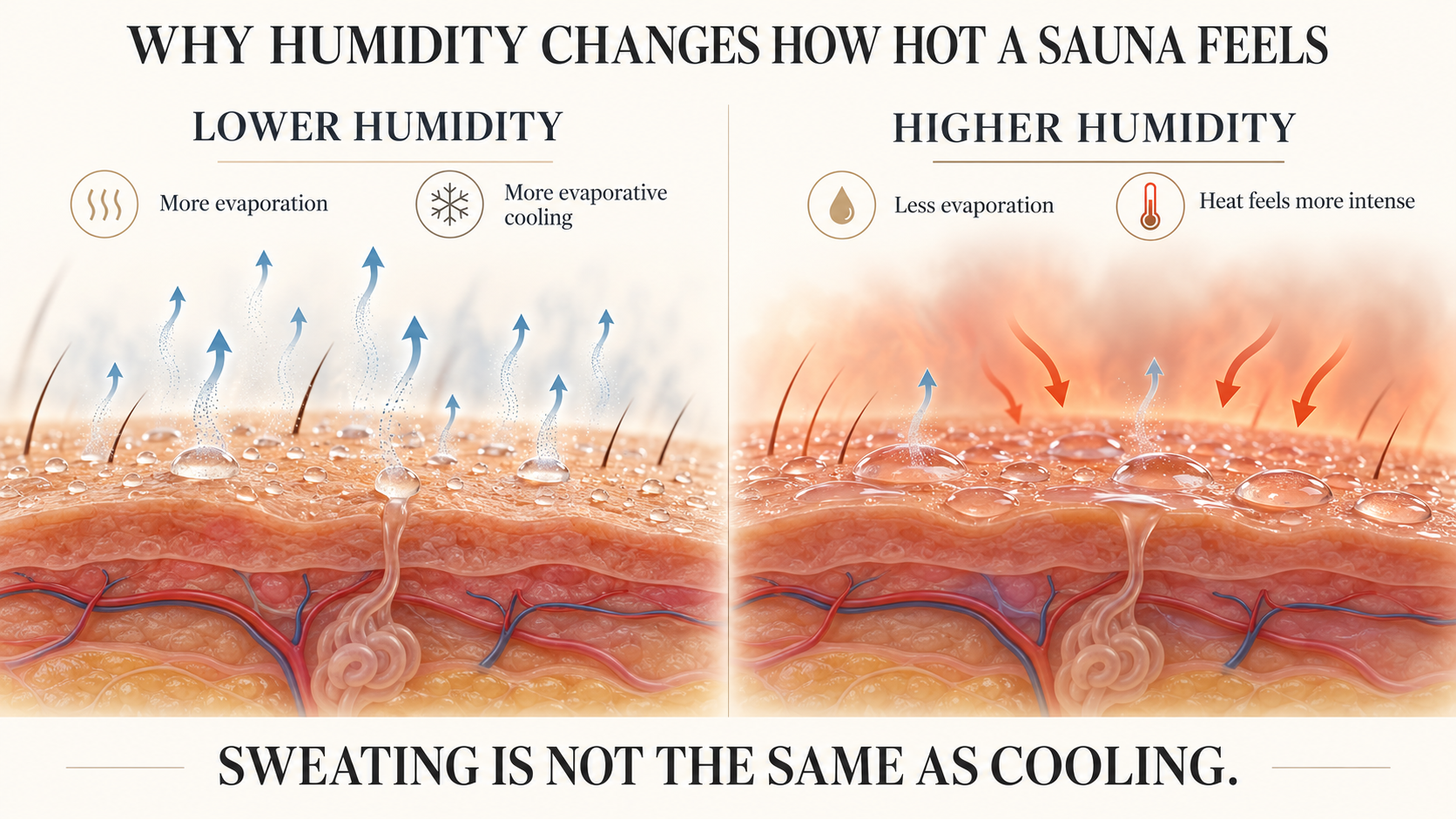
Sweating helps cool the body because liquid sweat can evaporate from the skin.
Evaporation takes heat with it.
When the surrounding air becomes more humid, evaporation becomes less effective.
Sweat may stay on the skin instead of evaporating quickly.
The body is still producing heat and receiving heat from the sauna, but one of its cooling mechanisms is working less efficiently.
The result?
The same air temperature may suddenly feel much more intense.
This is why a warm, humid environment can sometimes feel more oppressive than a hotter but much drier one.
Portable saunas can experience changes in humidity from:
You may not notice the humidity change visually, but your skin may notice it very quickly.
Imagine the display reaches 75°C.
Does that mean the entire sauna is now at 75°C?
Not necessarily.
The air near the sensor may have reached the target first.
Meanwhile:
may still be warming.
After another 15 or 20 minutes, those surfaces can become much hotter.
Now the body is surrounded not only by hot air but also by warmer surfaces.
The sauna can feel more intense even if the controller still shows exactly the same temperature.
This is sometimes described as the difference between:
air temperature
and
thermal soak.
A fully heat-soaked enclosure often feels more stable and more intense than a space that has only just reached its target reading.
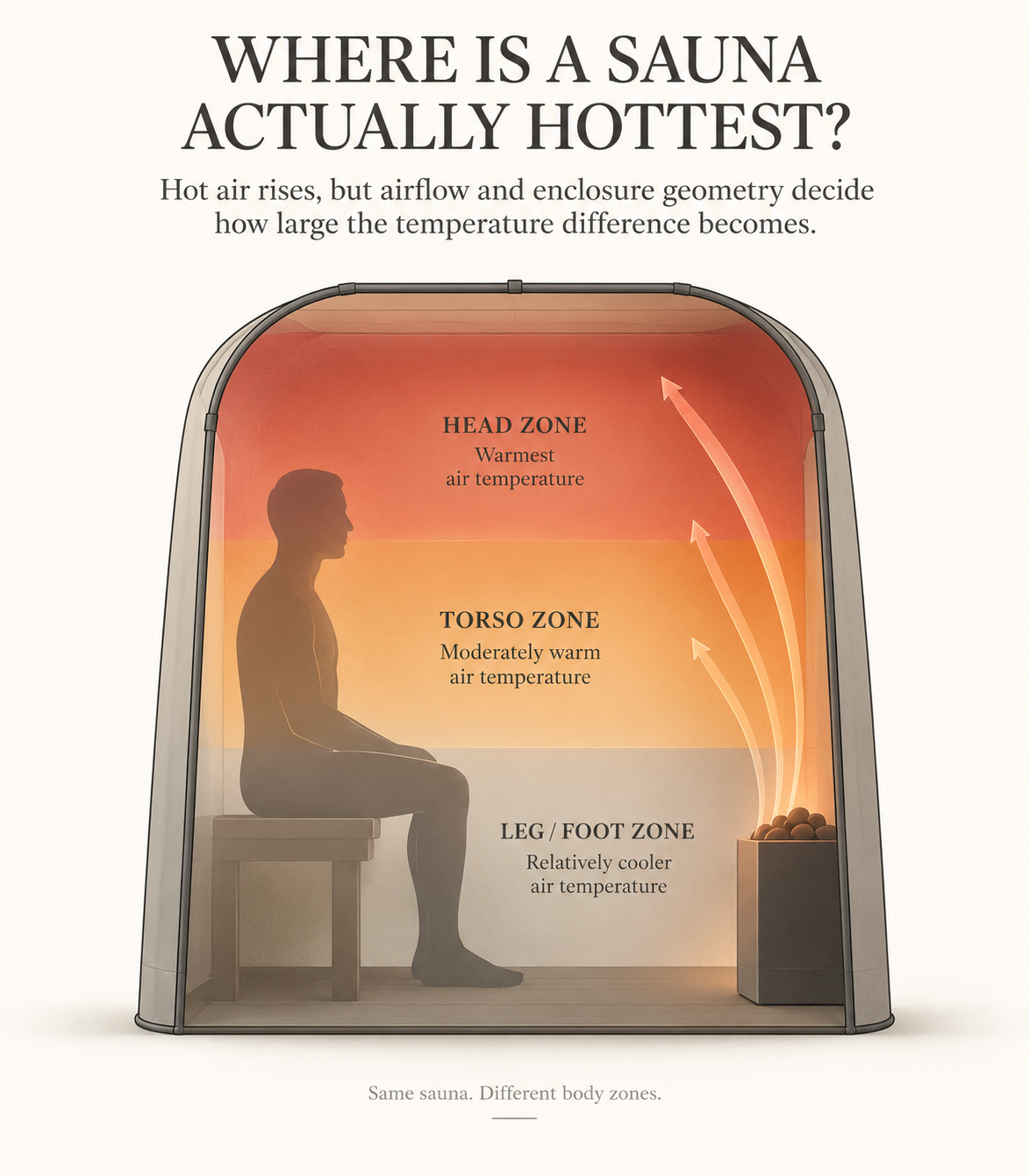
Hot air rises.
That simple fact has a major effect inside compact saunas.
The upper part of the enclosure can be significantly warmer than the lower part.
So moving your body by only 20 or 30 centimetres can change what you feel.
Your head and shoulders may sit in a hotter layer.
Your legs and feet may sit in a cooler one.
This is particularly noticeable in hot-air portable saunas, where the heater, outlet direction and tent geometry all affect how air moves.
A user sitting taller may feel more heat than a shorter user in exactly the same sauna.
Even changing chair height can alter the experience.
This is why a single temperature reading at one height does not always describe the whole interior.
Air movement changes heat transfer.
In a normal room, a fan often feels cooling.
In a sauna, the situation can be different.
If the moving air is hotter than your skin, increased airflow can increase convective heat transfer toward the body.
So a stream of hot air directed toward the torso or legs may feel much hotter than still air at the same measured temperature.
The effect depends on:
This is one reason two 1500W heaters can produce very different user experiences.
Electrical power alone does not tell you where the heated air actually goes.
Not all sauna heat comes from the air.
Far-infrared heaters, heated surfaces and hot internal components can transfer energy to the body through thermal radiation.
That means a sauna with a lower air temperature may still feel very warm if the user is close to a hot radiant surface.
This is also why comparing:
60°C infrared sauna
with:
80°C hot-air sauna
using temperature alone is not very useful.
They are different thermal environments.
One relies more heavily on radiant transfer.
The other relies more heavily on heating the surrounding air.
Your body responds to the complete environment, not just the temperature number.
Portable saunas do not operate independently from the room around them.
A sauna running in a 28°C room begins from a very different starting point than the same sauna running in a 15°C garage.
Ambient temperature can affect:
The same applies to cold floors, drafts and open windows.
A sauna placed on a cold concrete floor may lose more heat through its lower section than the same product sitting in a warmer indoor room.
That difference can change both the measured performance and the way the user experiences the heat.
Opening a portable sauna door for even a short time can release a surprising amount of warm air.
Hot air escapes.
Cooler room air enters.
But the controller may not immediately reflect the full change.
Depending on sensor position, the displayed temperature may remain relatively high while the user notices a sudden drop in comfort.
Then the heater begins rebuilding the thermal environment.
How quickly the sauna feels hot again depends on:
This is why “door recovery” can be a useful performance measure.
Real sauna use includes opening and closing the enclosure.
Testing only an untouched, sealed sauna tells only part of the story.
Sometimes the sauna has not changed.
You have.
Your perception of heat can vary depending on your condition before the session.
Factors may include:
Someone entering immediately after a workout may experience the same sauna differently from someone entering after sitting in an air-conditioned room for an hour.
A person who uses heat regularly may also perceive a session differently from someone who is not accustomed to it.
This does not mean the sauna is malfunctioning.
It means thermal comfort is partly physical and partly personal.
Small details matter.
A thick towel between the body and a heated seat changes heat transfer.
Wet clothing can change evaporation.
A bare upper body may respond differently from someone wearing a shirt.
Even posture can affect how much skin is exposed to airflow or radiant heat.
These differences are easy to overlook because they are not part of the sauna specification.
But they influence the actual session.
The sauna may be unchanged.
The interface between the sauna and the user is not.
A sauna temperature reading is only meaningful if you know:
where the sensor is.
Is it:
A sensor close to the heater may read higher than the average air temperature.
A sensor near the lower part of the sauna may read lower.
A sensor touching or sitting close to a heated surface may behave differently again.
This becomes especially important when comparing different sauna products.
“Reaches 85°C” sounds precise.
But without sensor position and test conditions, the number is incomplete.
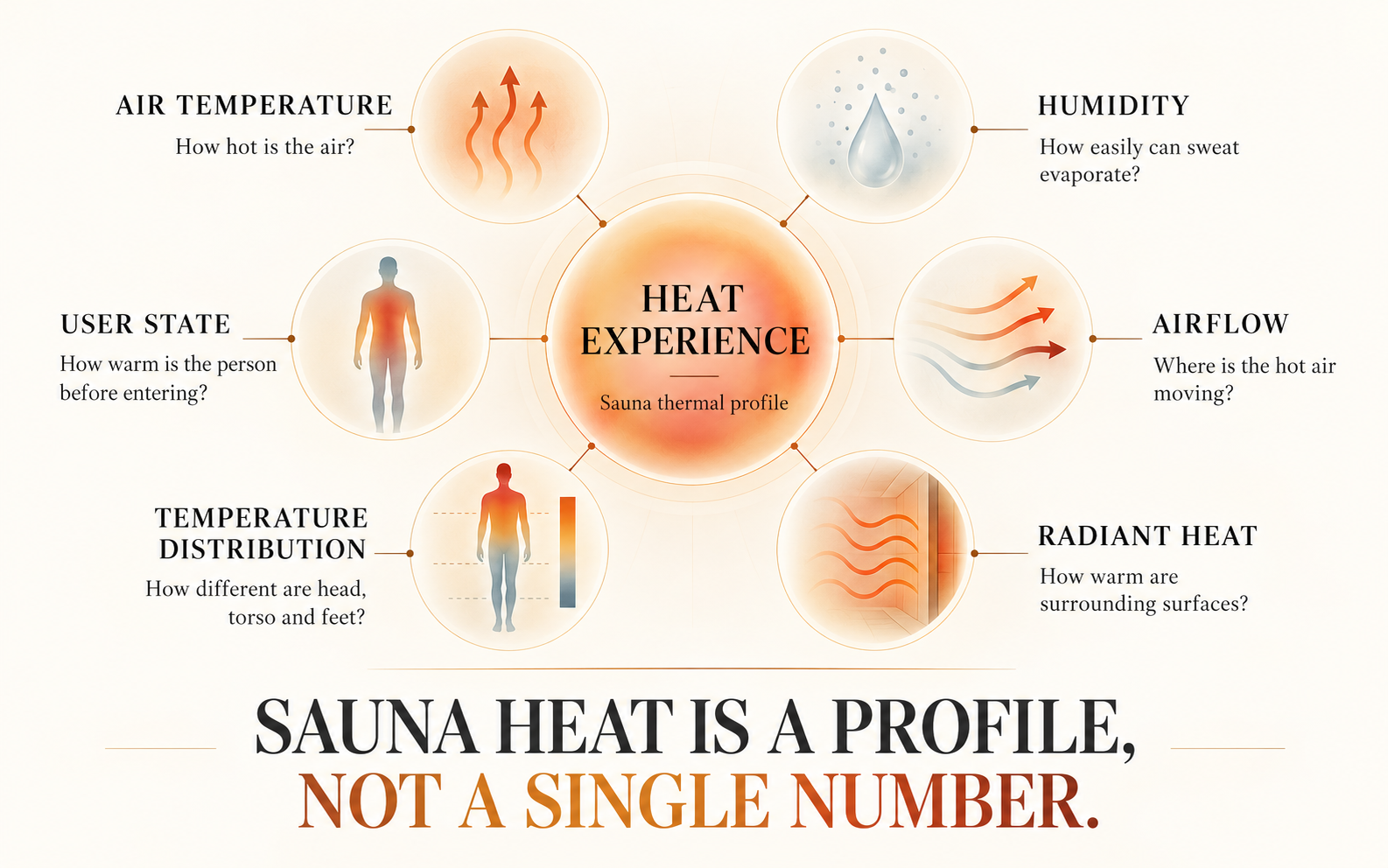
There is no single temperature that perfectly describes what every part of a sauna feels like.
A better way to understand sauna performance is to look at several things together:
How warm is the air?
How different are the head, torso and leg zones?
Does the temperature fluctuate significantly?
How warm are nearby heating surfaces?
How easily can sweat evaporate?
Where is hot air actually moving?
Together, these factors create the thermal environment the user experiences.
If you want to understand your sauna better, try one simple test.
Run the sauna under the same conditions on two different days.
Keep the following as consistent as possible:
Then measure temperature at three heights:
Head level
Chest level
Leg / foot level
You may be surprised by how different those numbers are.
Next, repeat the test after the sauna has been running for an additional 15 minutes.
The controller may show almost the same temperature.
The experience may not feel the same at all.
That small experiment illustrates an important point:
Sauna heat is a profile, not a single number.
For portable saunas, compact dimensions make thermal design especially important.
A small enclosure responds quickly.
That is an advantage.
But it also means:
A stronger heater can increase temperature.
It cannot automatically fix poor heat distribution.
Sometimes the better solution is not:
more power.
It is:
better control of where the heat goes.
Temperature remains one of the most important specifications in any sauna.
But it should not be treated as the whole story.
A sauna can feel hotter on one day because:
None of those factors automatically means the product is better or worse.
They simply remind us that heat is dynamic.
The body experiences a thermal environment, not a thermostat.
So the next time a sauna feels surprisingly hot even though the display looks completely normal, the most useful question may not be:
“Why is the temperature higher?”
It may be:
“What changed in the way heat is reaching me today?”
And that is a much more interesting way to understand sauna performance.
Related Reading

 EN