Two portable saunas can look similar on a specification sheet.
They may have comparable dimensions, similar heating power and even use the same general type of fabric.
Yet when the products are placed side by side, one may immediately feel more refined, more stable and easier to trust.
Why?
Usually, it is not because of one expensive component.
A premium impression is built through many small decisions: how the fabric sits on the frame, how the door opens, how the zipper feels, where the cables are routed, how the heater fits into the interior, and how simple the product feels once someone actually starts using it.
For portable saunas, these details matter even more because the product has to do two things at the same time:
feel like a real wellness product while still remaining portable.
That balance is harder to achieve than it looks.
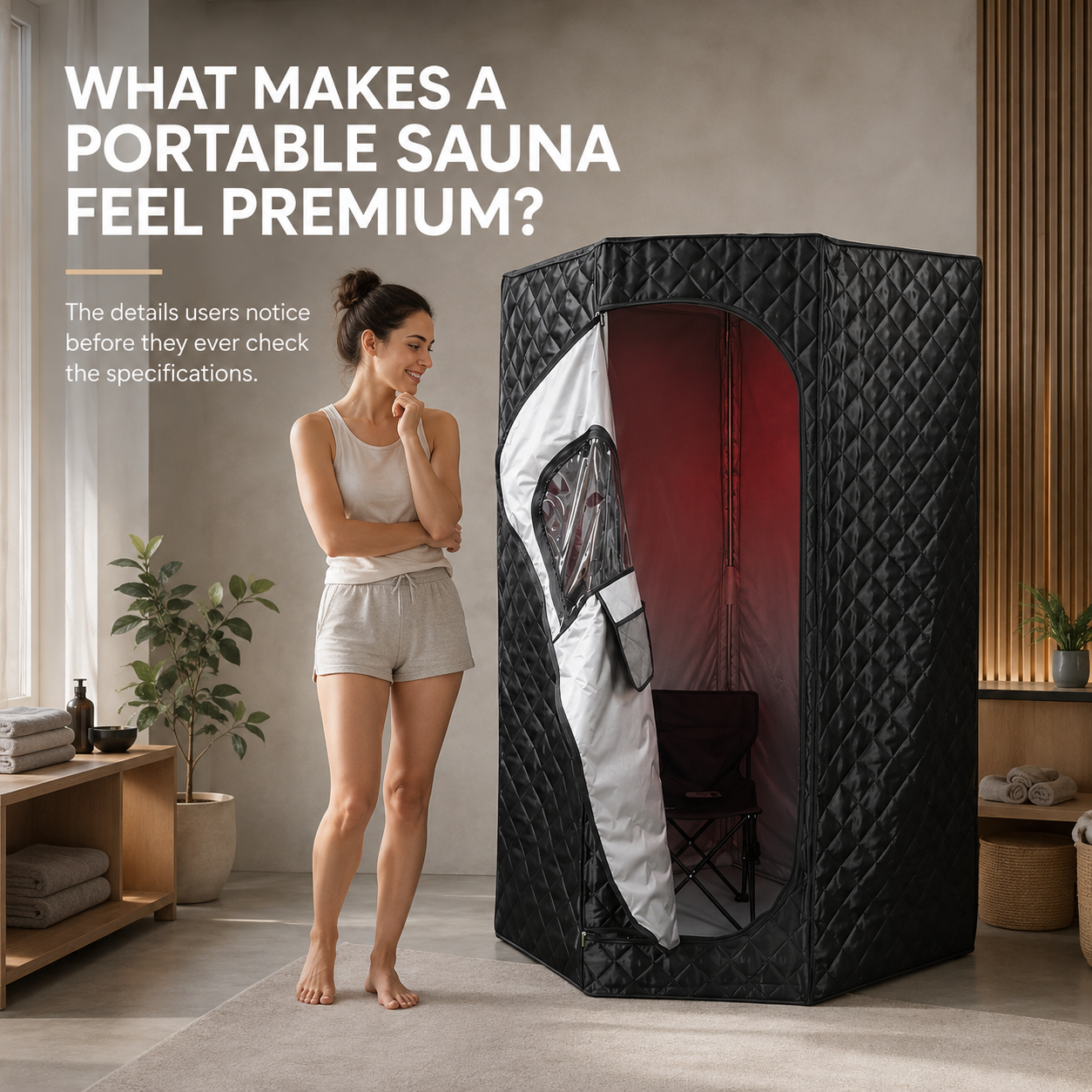
The first judgment happens visually.
Before a user checks the temperature or touches the controller, they already notice the shape of the product.
A well-developed portable sauna usually has a clear and controlled silhouette.
The frame stands straight.
The top does not sag.
The fabric does not pull unevenly around the corners.
The door sits where it is supposed to sit.
These details sound simple, but they strongly affect whether the product feels engineered or improvised.
Portable sauna fabric has to accommodate folding, installation and repeated use, so it cannot behave like a rigid cabinet wall.
But there is still a large difference between:
fabric that looks naturally fitted
and:
fabric that appears loose, wrinkled or incorrectly sized.
Too much tension can also create problems. It may distort the zipper, pull the door opening out of shape or make assembly unnecessarily difficult.
Good product design therefore is not simply about using “thicker fabric.”
It is about matching:
When those elements work together, the finished sauna looks calmer and more intentional.
The door is one of the most frequently touched parts of a portable sauna.
It is also where users quickly notice quality differences.
A user may never know what grade of steel is inside the frame, but they immediately notice when:
A premium door should feel simple.
That does not necessarily mean it needs a complicated design.
In many cases, the best experience comes from reducing unnecessary movements.
A portable sauna may technically be large enough for one person while still feeling inconvenient to enter.
The real experience depends on:
This is why a few centimeters in the right place can sometimes improve the user experience more than increasing the overall product size.
Users rarely describe a sauna by saying:
“The frame tolerance is excellent.”
They say:
“It feels solid.”
That feeling comes from the structure.
Portable sauna frames have to remain lightweight and easy to assemble, but once installed they should not feel temporary.
Common signs of a less refined structure include:
The structure also influences parts of the product that may appear unrelated.
If the frame geometry changes slightly:
So structural stability is not only a durability issue.
It is part of the visual and functional quality of the complete sauna.
Opening the door creates the second major impression.
A portable sauna interior does not need to be large, but it should feel organized.
The user should immediately understand:
where to sit,
where the heat comes from,
where the controls are,
and where their legs and arms are supposed to go.
This is particularly important in compact one-person saunas.
If the chair is positioned badly, even a reasonably large tent can feel crowded.
If heating elements, wires and controls occupy too much visual space, the sauna can feel more like equipment than a wellness product.
Exterior dimensions alone do not tell the whole story.
Two saunas with the same footprint may feel very different depending on:
Good design protects the user's personal space without unnecessarily increasing the shipping size of the product.
That balance is especially important for portable products.
One of the fastest ways to reduce the perceived quality of a portable sauna is to make the heating system look like it was added afterwards.
A heater, infrared panel or controller can be technically effective and still feel visually disconnected from the rest of the product.
Users notice things such as:
A more refined system integrates these elements into the product architecture.
That does not mean hiding everything.
It means every visible part appears to have a reason for being where it is.
For brands, this is an important distinction:
integration often communicates quality more effectively than adding another feature.
Temperature obviously matters in a sauna.
But the experience of heat is not defined by the maximum number on the controller alone.
In a hot-air sauna, users may notice:
In a far-infrared sauna, they may notice:
These are product-design questions rather than simply power questions.
A sauna that produces a very high reading at one point can still feel less refined than a system with better heat distribution and control.
Premium performance is usually about consistency and balance, not only intensity.
Heating equipment is not always silent.
Hot-air systems may contain:
Controllers may produce operating sounds.
Fabric and frames can also move slightly as temperature changes.
None of this automatically makes a product poor quality.
But the type of sound matters.
A smooth, consistent operating sound is very different from:
For a product positioned around personal wellness and home use, sound becomes part of the experience even if it never appears prominently on the specification sheet.
Users interact with some parts of a sauna repeatedly.
These small touchpoints often influence perceived quality more than the parts highlighted in marketing.
Examples include:
Do they feel solid and easy to find?
Can the user understand it without studying the manual every time?
Does the power cable naturally leave the sauna in a safe, tidy direction?
Does it feel intentionally positioned, or simply added because a window was required?
Does it stay flat and fit the internal floor properly?
Does it look like part of the product, or like a generic accessory added at the end?
Can the product realistically fit back inside after use?
No single one of these details makes a product premium.
Together, they create the impression that someone thought through the full experience.
A portable sauna has to be assembled.
That is part of the category.
The question is whether the installation process feels like a reasonable feature of the product or an inconvenience the customer has to tolerate.
An intuitive setup usually has:
The same applies when the sauna is packed away.
A product that is technically “portable” but takes a long time to disassemble, contains many loose components or is difficult to fit back into storage may not feel very portable in real ownership.
This is where product development often becomes less visible but more important.
Good portability is not achieved only by reducing weight.
It is created by designing the entire setup and storage process.
There is a temptation in wellness products to associate “premium” with more features.
More lights.
More heating technologies.
More accessories.
More controls.
Sometimes those features add real value.
Sometimes they simply add visual and operational complexity.
For portable saunas, a more useful question is:
Does this feature make the product noticeably better to use?
A clean, stable sauna with a well-designed heating system and an intuitive interface can feel considerably more premium than a product with a longer specification list but weaker execution.
The same principle applies to materials.
The most expensive fabric is not automatically the best choice if it:
Premium product development is therefore less about maximizing each individual component and more about making the complete product feel coherent.
When comparing portable sauna samples, it can help to look beyond the specification sheet.
Spend a few minutes with the product before turning it on.
Look at it from a distance.
Is the shape clean and balanced?
Open and close the door several times.
Does the movement feel natural?
Sit inside.
Do you immediately notice something blocking your legs, shoulders or line of sight?
Look at the cables and controls.
Do they feel integrated?
Then operate the product.
Listen to it.
Notice how the heat develops around the seated position rather than looking only at the highest controller reading.
Finally, take the product down and pack it again.
A lot of product quality becomes obvious during these simple interactions.
A premium portable sauna is rarely defined by one headline feature.
It is the result of:
Most users will never describe every one of these details individually.
They simply experience the result.
They may say:
“It feels well made.”
For product developers, that simple reaction is often the outcome of dozens of engineering and design decisions working quietly in the background.
And that is perhaps the most useful way to think about premium quality:
Not as one premium component, but as a product with fewer details that feel overlooked.
OHO develops portable hot-air, far-infrared and steam sauna platforms for brands selling through e-commerce, retail and distribution channels.
Depending on the product positioning, development can focus on areas such as:
A good starting point is not simply:
“How can we add more features?”
It is:
“Which details should the user notice—and which problems should they never have to notice at all?”
Users usually notice the overall structure first: fabric fit, frame stability, door operation, interior space and how well the heater, controls and cables are integrated. High quality is normally the result of these details working together rather than one premium material.
No. Fabric thickness is only one factor. Fit, insulation structure, flexibility, sewing quality, heat resistance and compatibility with the frame can all affect the finished product.
Not necessarily. Maximum temperature is important for certain product positions, but heat distribution, stability, control, airflow and overall user comfort also affect the experience.
Useful checks include overall shape, fabric tension, frame stability, zipper operation, entry space, seated comfort, heating layout, cable management, operating noise, setup difficulty and how easily the product can be packed again.

 EN
EN