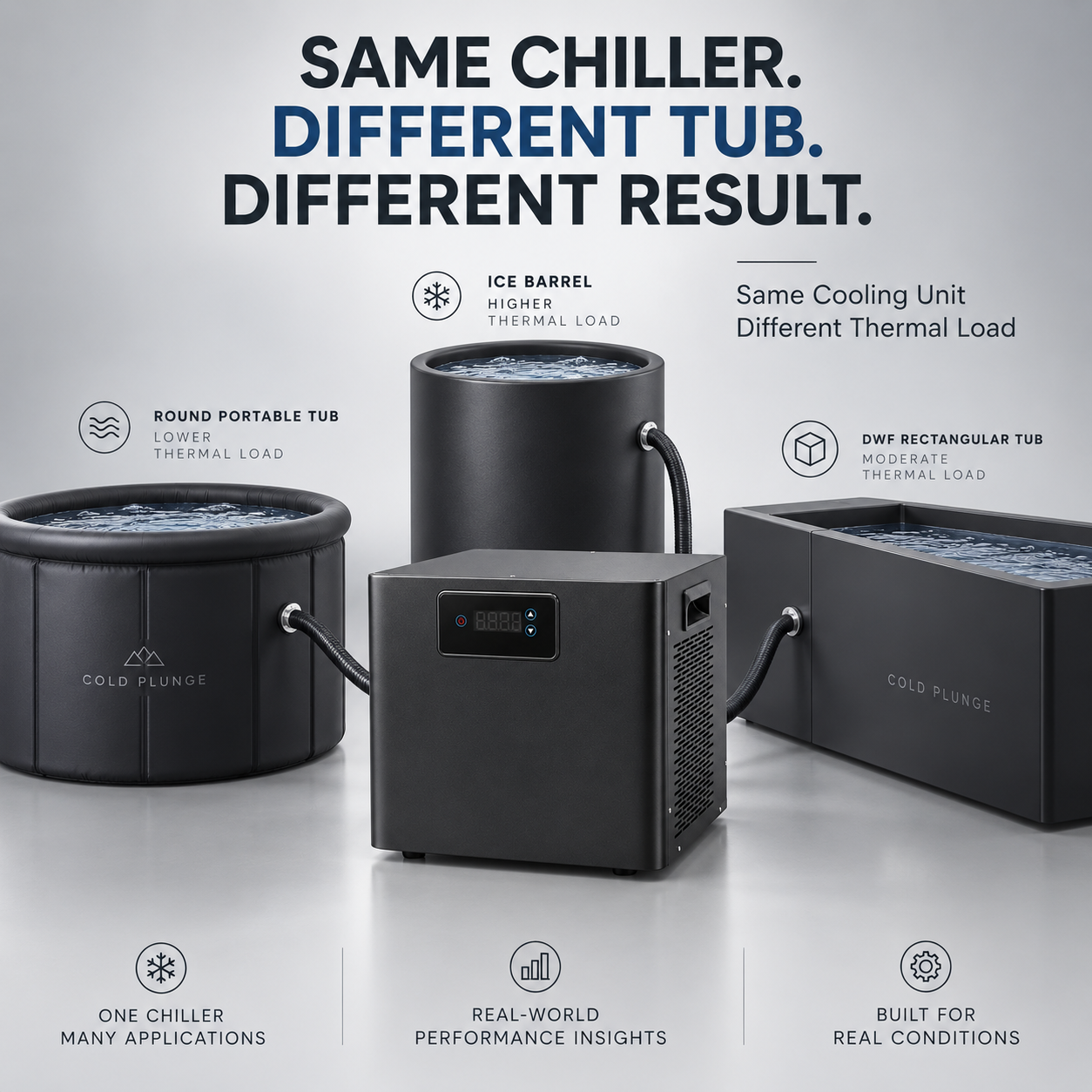
Two cold plunge systems can use the same chiller and still produce noticeably different cooling results.
One tub may reach the target temperature within a reasonable time. Another, connected to the exact same unit, may cool more slowly or struggle to hold the same temperature under warmer conditions.
It is tempting to blame—or credit—the chiller alone.
In reality, a cold plunge works as a thermal system.
The chiller removes heat from the water. At the same time, the tub, surrounding air, sunlight, plumbing and user all influence how much heat enters or moves through that system.
That is why a chiller specification should never be interpreted without understanding the tub it is connected to.
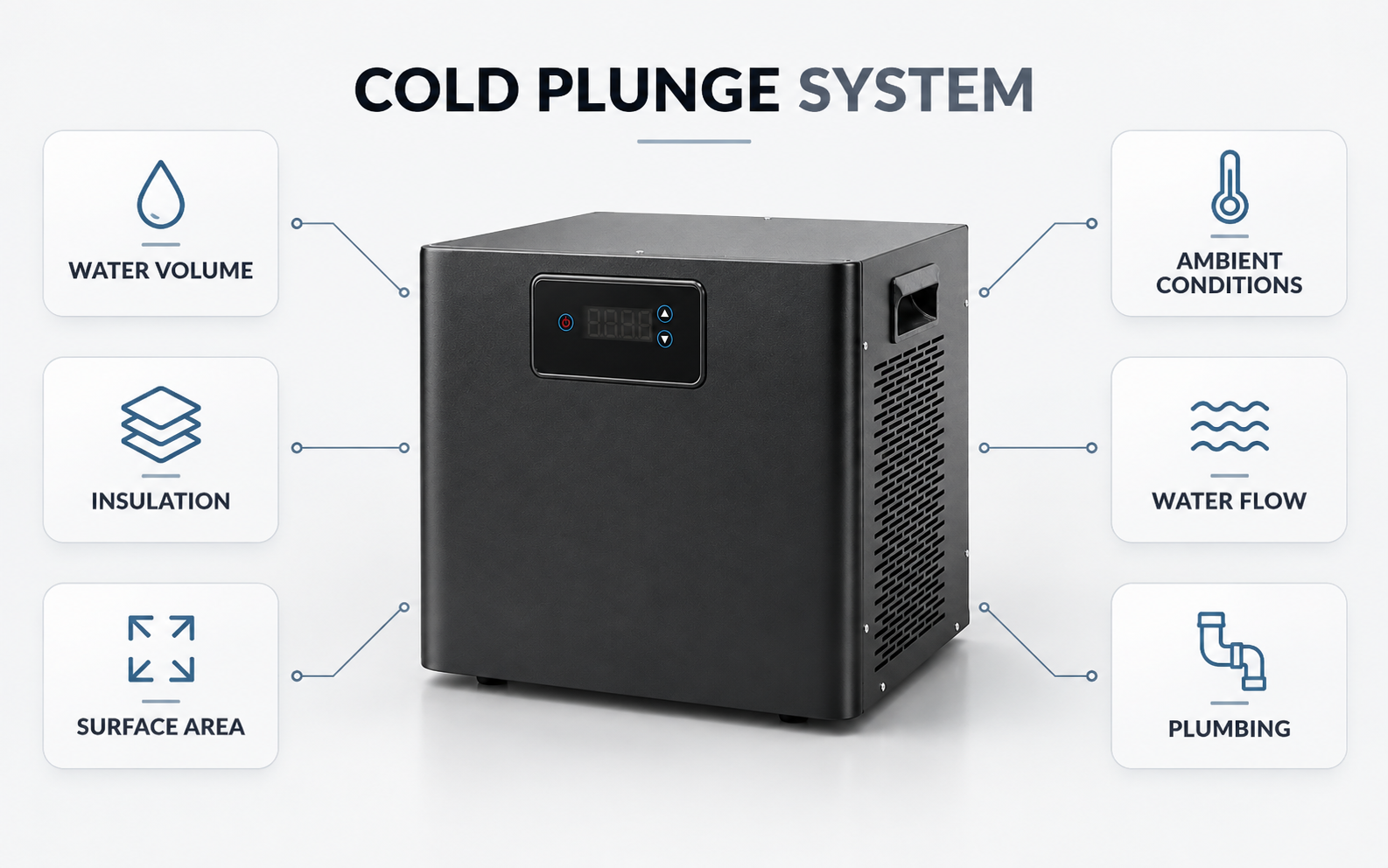
A cold plunge system can be simplified into three parts:
Heat entering the water
from the environment, user, pump and surrounding surfaces
↓
Heat moving through the water
through circulation and mixing
↓
Heat removed by the chiller
If the amount of heat entering the system changes, the same chiller will behave differently.
This is also why comparing systems purely by compressor horsepower can be misleading.
A label such as 0.3 HP, 0.5 HP or 1 HP describes part of the refrigeration system, but it does not tell you everything about how fast a complete cold plunge will cool.
The more useful question is:
How does this chiller perform with this tub, at this water volume, under these conditions?
The most obvious difference between cold plunge tubs is also one of the most important: how much water they actually hold during use.
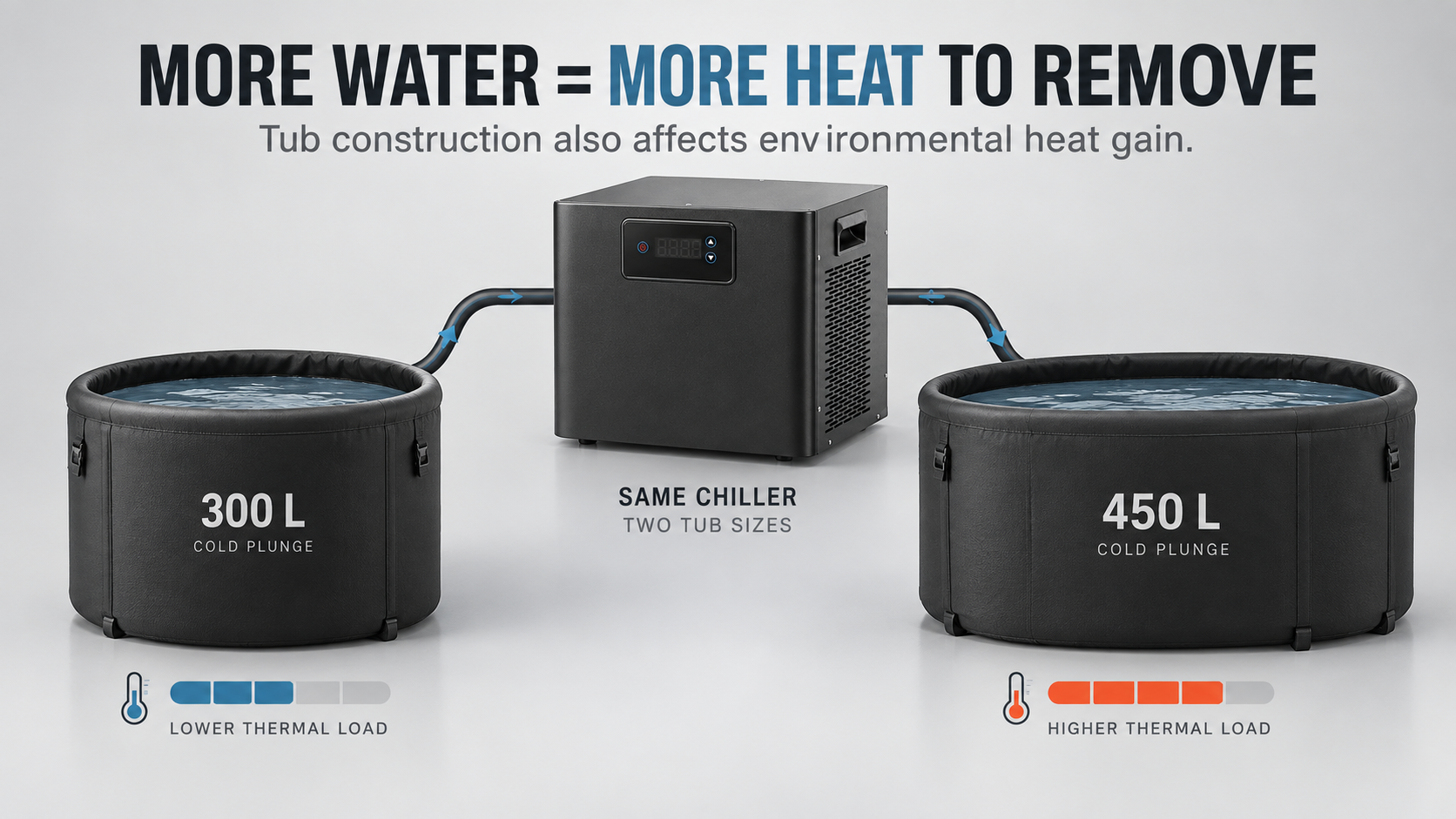
Water has a high heat capacity. The more water in the tub, the more heat the chiller needs to remove before the target temperature is reached.
The basic relationship is:
Heat to remove = water mass × specific heat capacity × temperature change
Consider two tubs starting at 25°C and cooling to 10°C.
A tub containing 300 litres of water requires approximately 5.2 kWh of thermal energy to be removed in the ideal theoretical case.
A tub containing 450 litres requires approximately 7.8 kWh.
That is roughly 50% more heat to remove simply because there is 50% more water.
And those numbers do not yet include heat continually entering from the surrounding environment.
This is why nominal tub dimensions are not enough.
Two products of similar external size may have quite different operating water volumes depending on:
When cooling performance is compared, actual working water volume matters more than the outside dimensions printed on the carton.
A cold plunge tub is not just a container.
Its walls separate cold water from a warmer environment, which means the tub construction influences how quickly heat can move back into the water.
Different cold plunge products may use:
But material names alone do not tell the whole story.
Effective insulation depends on the complete wall construction:
A visually thick wall is not automatically a highly insulated wall.
Likewise, two tubs described as “insulated” may behave differently once filled with cold water.
The most reliable way to understand this difference is through matched testing rather than material assumptions.
Water volume receives most of the attention, but the shape of the tub also changes the thermal equation.
Imagine two tubs that both hold 350 litres.
One is tall and narrow.
The other is wide and relatively shallow.
They contain the same amount of water, but they do not necessarily expose the same amount of surface or wall area to the environment.
That affects heat exchange.
A larger exposed water surface can interact more strongly with:
Wall area also changes how much of the cold water is separated from warmer surroundings by the tub structure.
This is one reason a rectangular DWF plunge, round plunge and tall barrel should not be assumed to perform identically just because their capacities are similar.
A well-designed cover can reduce environmental exposure and, outdoors, help block direct solar load.
But covers also change evaporation and airflow at the water surface.
For that reason, “cover on” and “cover off” should be treated as two different test conditions rather than assuming one universal percentage improvement.
For product testing, consistency matters more than assumptions.
A cold plunge does not operate in a laboratory vacuum.
A system tested indoors at 20°C is working under very different conditions from the same system running outdoors at 32°C.
The colder the water becomes relative to its surroundings, the greater the temperature difference driving heat back toward the water.
Outdoor installations add other variables:
The chiller is also affected by its environment.
Most portable cold plunge chillers reject the heat removed from the water into the surrounding air.
If that hot exhaust air cannot leave the area—or if the chiller is operating in very warm ambient conditions—its refrigeration system has a harder operating environment.
So when two cooling-time claims are compared, ambient temperature should never be missing from the test information.
“Cools to 5°C” means much less without knowing where and under what conditions that result was achieved.
Outdoor cold plunges face another variable that indoor testing often misses: solar radiation.
A tub placed in full sun receives energy directly from sunlight.
The water surface, tub wall and cover can all absorb some of that energy depending on their materials and construction.
This means the chiller is no longer only removing the heat that was already in the water.
It is also fighting against heat that continues to enter throughout the day.
Moving the same system into shade can therefore change real-world cooling behavior without changing the chiller at all.
For outdoor product testing, it is useful to record:
Indoor / shaded outdoor / direct sun
as separate operating environments.
Cooling capacity is only useful if cooled water is properly circulated.
In an external-loop system, water typically travels:
Tub → pump → filter → chiller → tub
Every component in that loop affects flow.
Examples include:
Restricted flow can reduce system performance or create a larger temperature difference between different parts of the water circuit.
At the same time, simply increasing flow without limit is not necessarily better. Heat exchangers are designed to work within particular operating ranges.
The correct flow should therefore be evaluated according to the actual chiller and water-circuit design.
Even if the external loop is operating correctly, poor water movement inside the tub can create local temperature differences.
The water close to the return inlet may be colder than water elsewhere in the tub.
A temperature sensor in the wrong position can therefore make the system appear colder—or warmer—than the average user experience.
Hoses often look like minor accessories.
They are not.
Longer plumbing adds:
Uninsulated cold hoses can also exchange heat with the surrounding environment and develop condensation.
None of these effects necessarily creates a major problem on its own.
But together they explain why a chiller tested with a short, optimized factory loop may perform differently when installed several metres away from the tub with a different pump, filter and hose arrangement.
This is particularly important when brands compare a complete matched system with a chiller that is sold as a standalone component.
“Cooling time” is meaningless without a starting temperature.
Cooling water from:
18°C → 10°C
is a completely different task from:
28°C → 10°C.
The second system has substantially more heat to remove.
This sounds obvious, yet product comparisons regularly quote cooling times without clearly stating the starting water temperature.
The same applies to the target temperature.
As the water becomes much colder than the surrounding environment:
That is why the last part of a pull-down test can tell you as much as the beginning.
A system that cools quickly at first but slows significantly near its target may behave very differently from one designed to maintain low temperatures efficiently over time.
A chiller has to move heat somewhere.
For an air-cooled system, that heat is discharged through the condenser into the surrounding air.
If the unit is placed:
hot discharge air may circulate back toward the condenser.
The chiller then has to work in warmer air than the room itself.
Adequate airflow around the unit is therefore part of correct system setup.
This may seem like a chiller issue rather than a tub issue, but tub shape and installation often determine where the chiller ends up being placed.
A compact home setup can create very different operating conditions from an open test room.
One number on a display can create false confidence.
Where is that temperature being measured?
Possibilities include:
Those readings are not automatically identical.
During active cooling, temperature differences may exist around the system before circulation fully mixes the water.
For meaningful testing, it is better to define:
sensor type + sensor position + measurement time
rather than reporting a temperature number by itself.
For a cold plunge system, the temperature experienced in the tub matters more than the coldest point somewhere inside the cooling circuit.
A useful cooling test does not need to be complicated.
It simply needs to keep the important conditions visible.
For example:
| Test Condition | Record |
|---|---|
| Tub model | Shape and construction |
| Working water volume | Actual litres filled |
| Starting water temperature | °C / °F |
| Target temperature | °C / °F |
| Ambient temperature | °C / °F |
| Installation | Indoor / shade / direct sun |
| Cover | On / off |
| Pump & flow condition | Defined configuration |
| Hose configuration | Diameter + approximate length |
| Chiller placement | Defined ventilation clearance |
| Temperature measurement | Defined sensor location |
| Result | Time to target + holding performance |
If two tubs are tested using the same chiller under these same conditions, the differences become much easier to understand.
Without these details, a cooling-time number can look precise while actually telling very little.
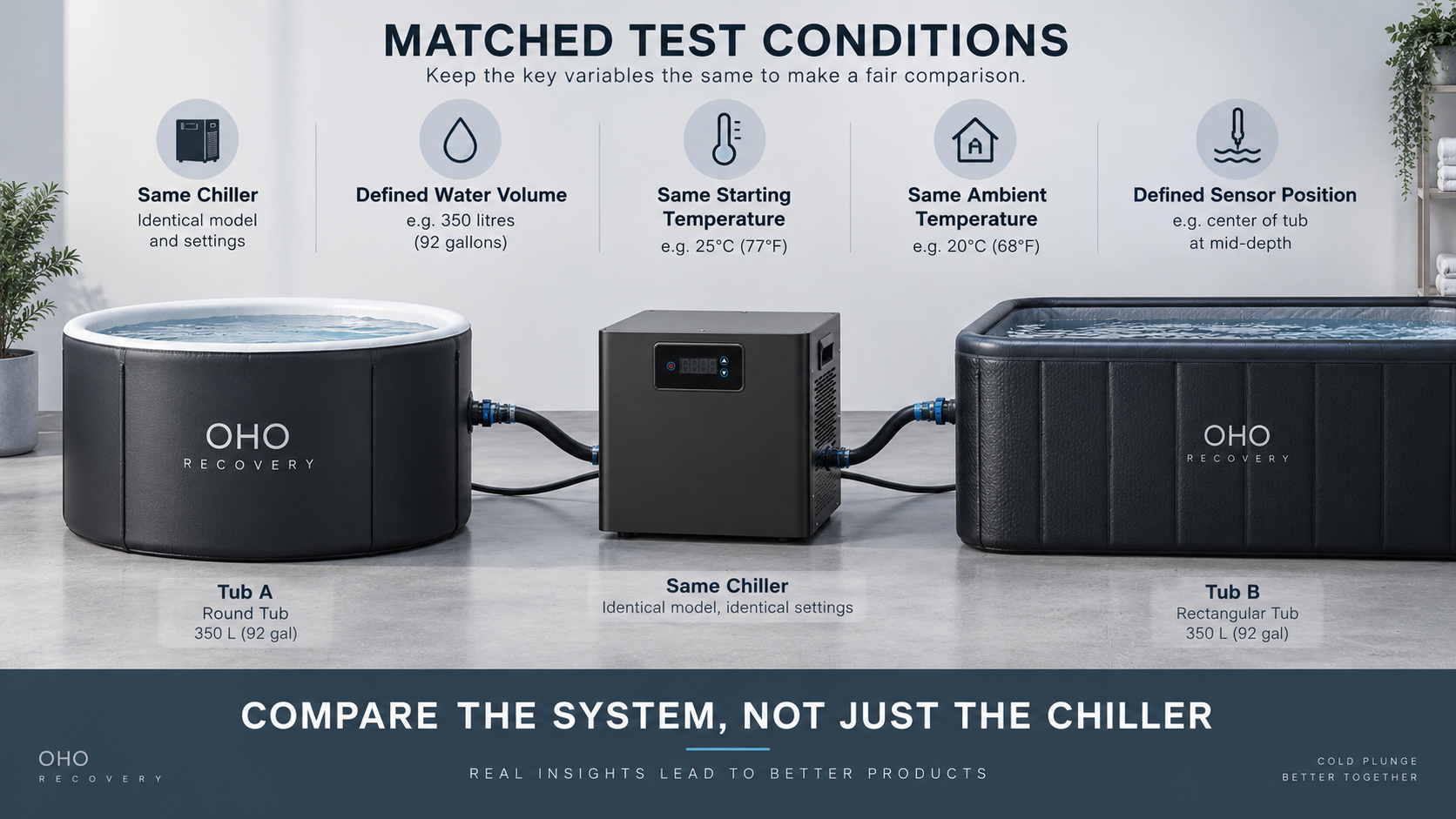
The most useful takeaway is simple:
The chiller does not determine cold plunge performance by itself.
The tub affects:
That changes the way a cold plunge system should be evaluated.
Instead of asking only:
“Is this a 0.5 HP or 1 HP chiller?”
a more meaningful question is:
“How does this tub and chiller perform together under the conditions my customer is likely to use it in?”
That is also why matched-system testing matters.
The best-performing chiller on paper is not automatically the best-performing cold plunge system.
The tub, cooling unit, water circuit and environment all have to work together.
For brands developing portable cold plunge products, cooling performance is most useful when it is validated as a complete configuration rather than as isolated component specifications.
At OHO, portable cold plunge development can involve different tub formats, cooling architectures and chiller configurations depending on the intended product.
When comparing or developing a system, the most useful starting information includes:
These details provide a much clearer basis for testing than horsepower alone.
A good cold plunge is not simply a tub connected to a powerful chiller.
It is a thermal system in which every major component has been considered together.

 EN
EN